



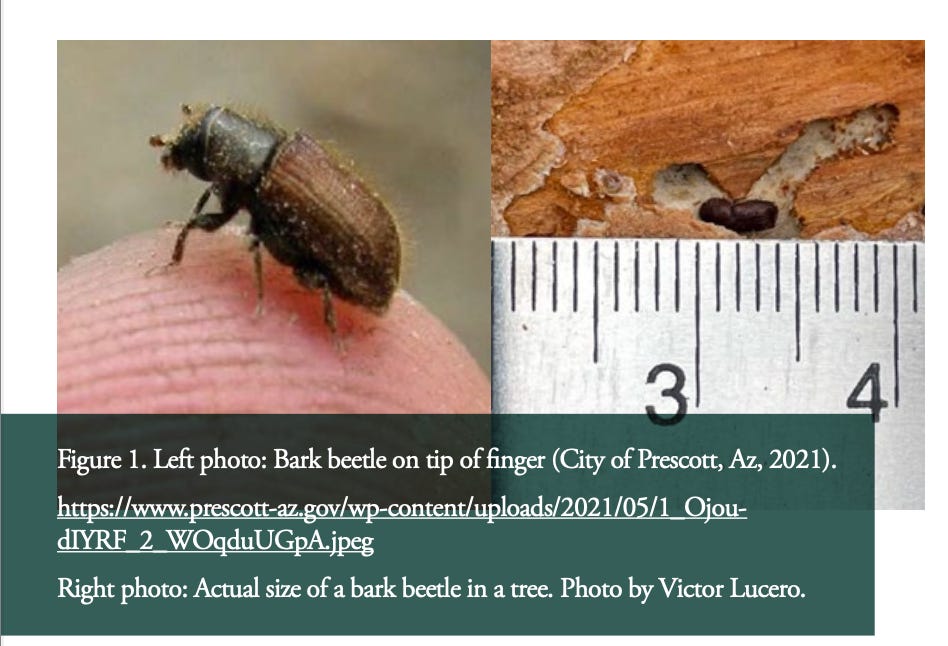
Bark beetles — native insects measuring approximately one-third inch or smaller that typically attack weakened trees — have reached elevated population levels in Lincoln and Otero counties due to fire-damaged timber and persistent drought conditions.
After major wildfire disturbances, these beetle populations can swell and begin attacking even healthy trees.
“When those bugs flew out of all those fire-damaged trees this spring, they found a lot of trees that were very stressed by drought,” said Nick Smokovich, district forester for the New Mexico State Forestry Division’s Capitan District Office. “Without that sap and the sap pressure, they were able to get into those drought-stressed trees and successfully attacked them and bred more beetles.”
Management Strategies in Lincoln and Otero
State Forestry is working with private landowners in Lincoln and Otero counties on comprehensive forest health projects that simultaneously reduce fire risk and improve tree resilience to beetle activity.
The approach involves thinning overcrowded forests to sustainable densities, retaining the largest and healthiest trees while removing competition for limited water resources.
Research demonstrates that stands with higher tree density and trees with lower growth rates experience greater mortality from bark beetle populations.
Cloudcroft residents can access federal funding through an NFL (Non-Federal Lands) Grant administered by the Otero Soil and Water Conservation District.
Unlike typical programs where landowners hire contractors, this project will pay contractors directly to remove hazardous trees — including large declining trees near homes that require specialized climbing and removal.
This article continues after a brief message. Thank you to our sponsor, The Elk Shed:

“We’re writing the treatment plans so that will outline how much funding we can allocate for each project,” Smokovich said.
Treatment work is scheduled to begin this winter, timed strategically for when beetles remain inactive from October to February. It is recommended not to leave large-diameter felled trees on the ground longer than 30 days, as bark beetle populations can continue building up in stored wood and infest nearby trees.
The state is also implementing Wildland Urban Interface (WUI) buffers — heavily thinned fuel breaks — along community boundaries under House Bill 175.
The first New Mexico project will address the southern boundary between Ruidoso and Ruidoso Downs that remained unburned last year. Similar work is planned for Cloudcroft.
Identification and Response
Landowners should monitor their trees for several warning signs including pitch tubes on pines, white fir, and spruce trunks (Douglas-fir does not produce visible pitch tubes but will show boring dust); reddish or brownish boring dust at the tree base or in bark crevices; fading crowns with yellow, red, or brown needles; groups of dead or dying trees of the same or closely related species; and BB-sized emergence holes.
If trees are found with live bark beetles actively present, they should be promptly felled and removed from the property to prevent further spread. When cutting trees generates slash material, it should be immediately removed, burned, or chipped and dried, as untreated slash can attract additional beetles and serve as a breeding ground for new infestations.
Landowners should avoid actions that stress trees further.
Any tree damage forces the tree to expend precious moisture in the form of sap to address the injury, weakening the tree and making it more susceptible to beetle attack. Common injuries result from nearby construction, improper pruning, or landscaping practices.
Additionally, fertilization should be avoided as it promotes unsustainable growth and exerts further moisture stress on trees.
The Science: Mass Attacks
The insects bore through bark to reach the phloem — the nutritious soft inner bark layer where they feed and reproduce. Trees defend themselves by producing pitch tubes, which appear as gooey masses of sap exuding from entrance holes as the tree attempts to trap invading beetles.
Successful colonization requires coordinated mass attacks rather than individual beetles. When bark beetles discover a damaged tree where sap has already been depleted, they emit an attractant pheromone to recruit other beetles to overwhelm the tree’s defenses.
The beetles create egg galleries in the fresh phloem, and when eggs hatch, the larvae feed outward at right angles from the gallery, creating characteristic tunnel patterns. Meanwhile, bark beetles carry blue stain fungi on their bodies that infect the tree’s cambium. These fungal spores germinate and disrupt water transport in the xylem.
This disruption, combined with the feeding activity that girdles the host tree, accelerates mortality. In spring, adult beetles emerge from the host through small BB-sized holes and seek new trees to infest.
The Dendroctonus bark beetle currently affecting the region specifically targets ponderosa pines and Douglas-fir. Piñon pines face separate activity from Ips bark beetles, with mortality visible on south and west-facing slopes at lower elevations.
Aerial surveys in 2024 documented approximately 70,000 acres with bark beetle-killed trees across New Mexico forests and woodlands.
Areas that experienced moderately severe burns face the greatest risk, requiring monitoring of fire-stressed trees within and immediately outside fire perimeters for at least two years. According to Dr. John Formby, forest entomologist with New Mexico ArborPro, some trees with 80-90% scorched canopy can actually survive after a fire, meaning not all fire-damaged trees should be immediately removed.
Individual Tree Protection
For residents with small numbers of pines, preventative insecticides containing the active ingredient carbaryl or permethrin can be applied to the trunk and larger branches before spring beetle emergence. These treatments can protect trees for six months to a year.
However, insecticides must be applied prior to beetle attack — once a tree is infested, it is too late for chemical intervention. Smokovich’s office has provided landowners with information about commercially available products, though no cost-share program currently exists.
For Douglas-fir or spruce, MCH (3-methylcyclohex-2-en-1-one) can be used to prevent bark beetle attacks. MCH is an anti-aggregation pheromone that functions like posting a “no vacancy” sign on the tree and is safe to use with minimal environmental impact.
Watering trees can bolster their natural defenses, though this does not guarantee protection since a mass attack can overwhelm even healthy, thriving trees.
The Bigger Picture
Bark beetles are a natural component of forest ecosystems, providing food for other insects and animals while creating habitat for cavity-nesting birds and bats.
Their activity naturally increases the diversity of tree age and size across the forest.
However, current stand densities are believed to exceed the natural range of historic variability due to past forest management policies. Fire suppression and over-grazing during much of the 20th century, while intended to protect forests, contributed to unnatural tree densities that have programmed forests for both fiercer wildfires and more severe beetle outbreaks.
Many people worry that numerous standing dead trees will worsen wildfire conditions. However, beetle-killed trees typically shed their needles within a year of dying, and fire spread rates dramatically decline once needles are lost. While dead snags present some threat of spotting when fires burn nearby, they do not create as significant a risk for massive fire spread as might be imagined.
Forests remain dynamic systems, always in a state of change.
Bark beetles have played a role in creating the forests we see today and will continue to alter the landscape by thinning weakened trees, creating gaps that promote understory growth, and providing habitat for other forest inhabitants. While tree losses continue, these native insects ultimately serve as agents of natural forest thinning and renewal.
Optimal forest resilience depends on adequate winter precipitation. “A good winter with plenty of snow to really rehydrate our watershed and get these trees as healthy as possible for the upcoming spring bark beetle flight,” Smokovich said.
Landowners interested in forest health projects or funding can contact the State Forestry Division’s Capitan District Office, where applications are currently being accepted.
According to State Forestry, the number one defense against bark beetles remains preventive forest care through strategic thinning and controlled burns.
This story also appears in the January issue of the Mountain Monthly newspaper, now available across the village of Cloudcroft.

Thank you to our sponsor, Cloudcroft Sandwich Shop:

Cloudcroft Reader is proud to be sponsored in part by great companies like:
Be in the Mountains Yoga & Massage
A cozy space for yoga and massage therapy at the Village PlazaOsha Trail Depot
Your destination for unique, hand-crafted treasuresCloudcroft Sandwich Shop
In the heart of downtown Cloudcroft, New MexicoJohn R. Battle, CPA, CVA, MAFF, CMAA
Personal & Business Taxes, Tax Planning & ConsultingThe Stove and Spa Store
We offer a variety of services to ensure your hearth and spa dreams are met!The Lodge at Cloudcroft
Landmark Choice Among New Mexico ResortsSacramento Camp & Conference Center
Come to the Mountain — Let God Refresh Your SoulNew Mexico Rails-to-Trails Association
We Convert Abandoned Railroad Lines Into Recreational TrailsLaughing Leaf Dispensary
Discover a world of wellness at Laughing LeafInstant Karma
Adventure Within: Transformative Yoga, Ayurvedic Wisdom, Nourishing Organics, Fair Trade BoutiqueOff the Beaten Path
Eclectic gifts & original artworkFuture Real Estate
Raise your expectations.Ski Cloudcroft
The Southernmost ski area in New MexicoCloudcroft Therapeutic Massage
Maximizing Movement, Quality of Life ImprovementHigh Altitude
Your favorite little outdoor outfitter on Burro AvenueBlushing Yucca Esthetics
✨ Book your glow-up today✨The Elk Shed
Purveyors of Southwest Mountain Goods & FineryThe PAC
Pickleball Addicts of Cloudcroft—Pickleball in the CloudsPeñasco Valley Telephone Cooperative
For all the ways you love to connectBre Hope Media
Professional photo and video services
Now, we can put the power of the Mountain Monthly newspaper to work for you.
Advertise in Mountain Monthly and Cloudcroft Reader for total market coverage.
Cloudcroft Reader serves more than 3,200 active email subscribers and more than 14,000 social media followers. With the Mountain Monthly, widely available across the village for free, circulation is higher than ever, and the Monthly informs more than 4,000 followers on Facebook.
Together, our platforms provide comprehensive market coverage: locals, seasonal residents, and visitors who want to stay informed about the Cloudcroft community.
Reach the people engaged with Cloudcroft — locals, seasonals, and visitors. Let us help you reach your best customer prospects with your compelling message. What are you waiting for?

Cloudcroft Stars make local news.
Thank you for supporting independent, factual, and fair coverage.


Thanks for reading Cloudcroft Reader! Subscribe for free to receive new posts and support my work.
Great information! Now let's hope we get some good snowfall this winter to keep those pesky bark beetles at bay!