

By Sean Chaffin
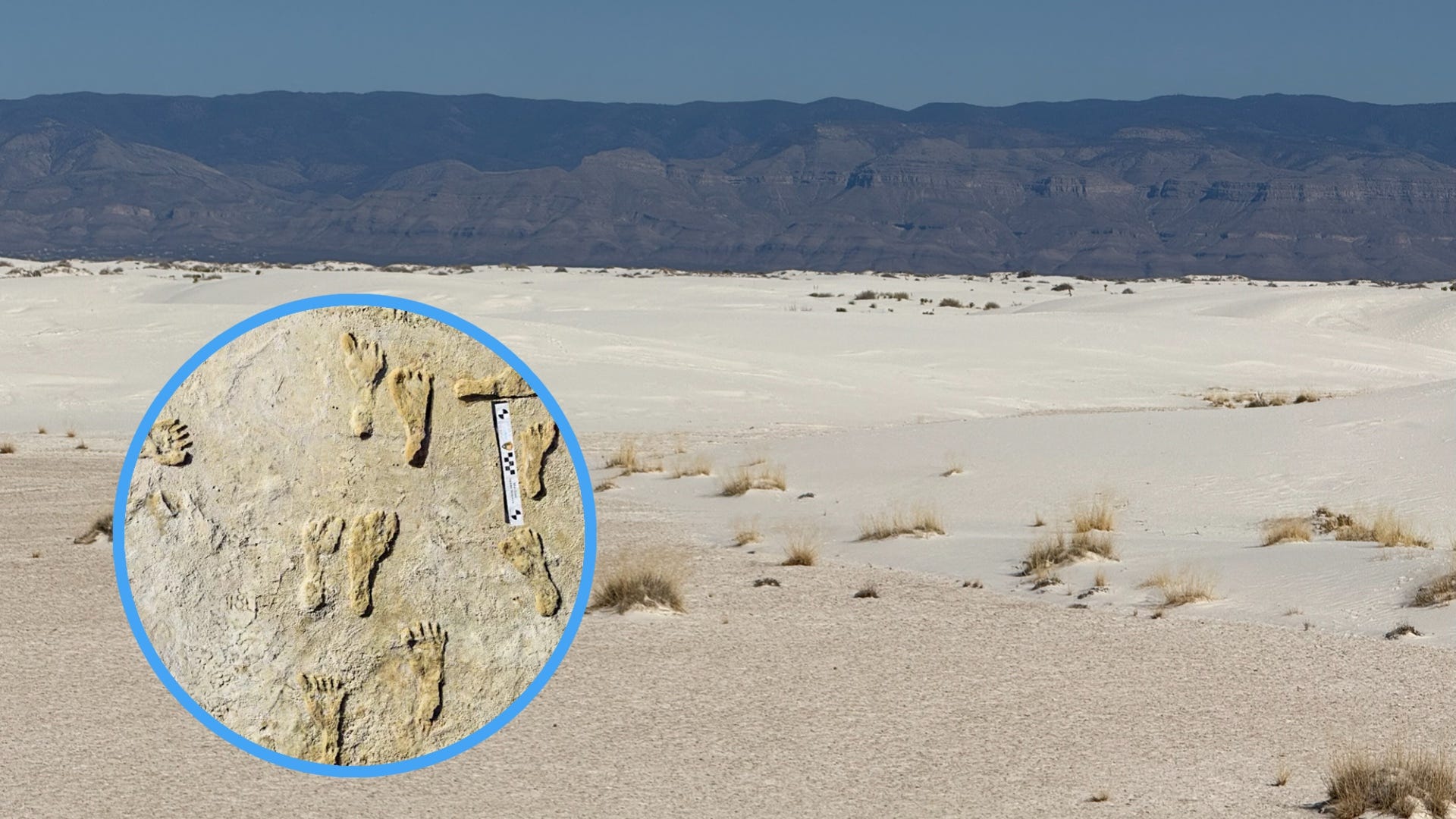
Long before the iconic gypsum white sands, grasslands at the long-vanished Lake Otero sustained mammoths, sabertooth cats, giant sloths, and the people who lived beside them thousands of years ago.
Pleistocene mud kept their story.
Shifting Sands Discovery
Footprints continue one after another. A smaller second set of prints suddenly appears. The two sets continue a short distance, then the smaller prints vanish, leaving a single set again.
This was the scenario researchers at White Sands National Park faced when unearthing a series of fossilized footprints. They found similar tracks amid the shifting sands of the world's largest gypsum dunefield.
Scientists believe that thousands of years ago, a mother and child traversed what was then a lakebed. The tracks provide evidence of a mother carrying her young child, occasionally resting and setting the youngster down to walk on his or her own.
This is one set of unique fossilized footprints that may date back as far as 23,000 years, revealed in the windswept national park that covers about 146,000 acres.
The park recently unveiled the 0.8-mile Ice Age Trail, formerly the Playa Trail, where visitors can walk among replica prints and see how ancient humans roamed the area.
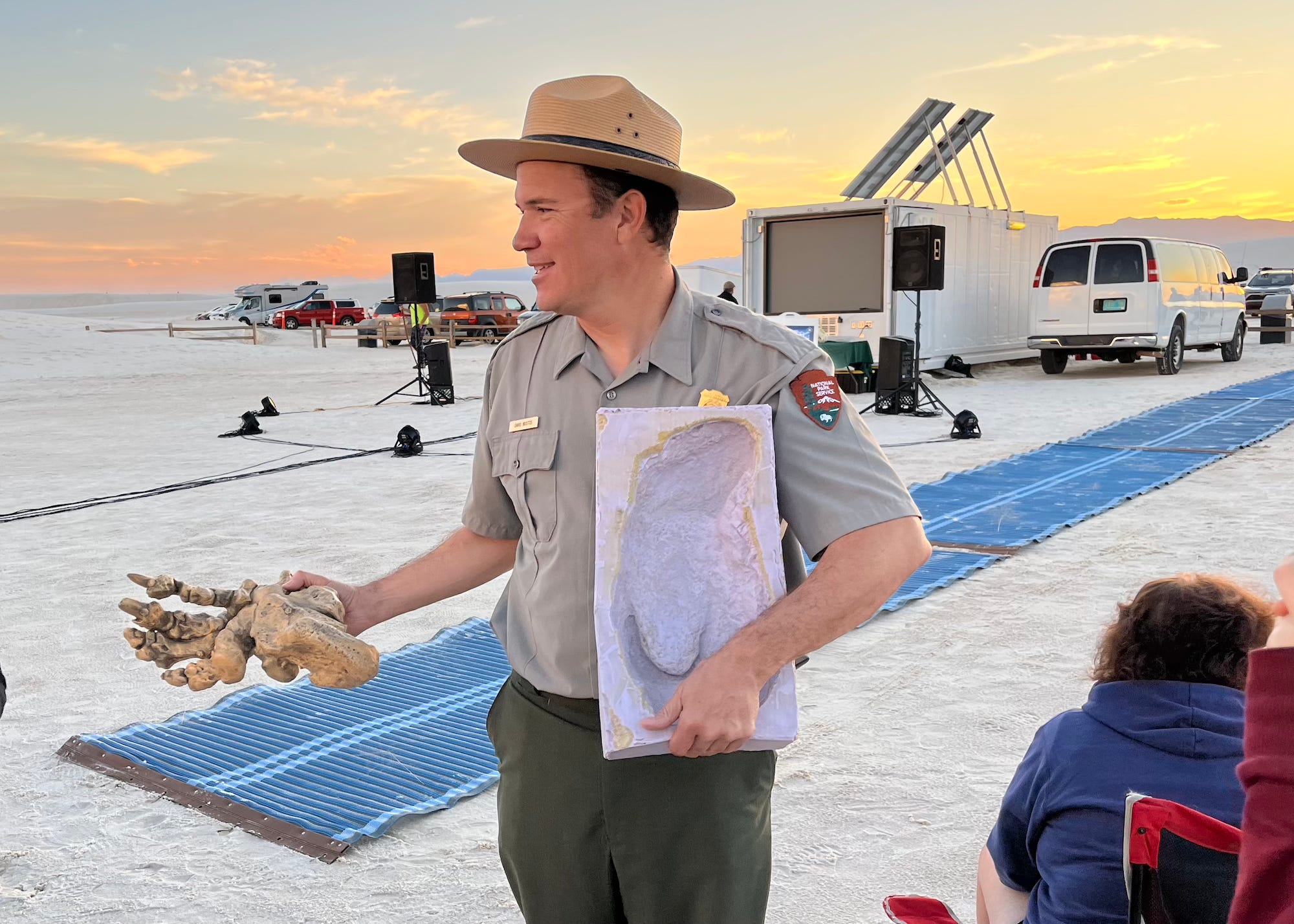
Resource Management Program Manager David Bustos took a deep look at the park’s fossil footprints on Oct. 25 during the season’s final Full Moon Night, capping a month that also included National Fossil Day.
“In the tracks, we see incredible stories that are left behind,” Bustos says. “What’s fun about these stories is that many tell (of things) you’d do today. You might see a kid jumping in puddles of water, or a mother carrying a child and putting him down and picking him up. In other places, people are going out and gathering whatever they need to sustain their family, food or hunting or other things like that. Those are many of the stories that are incredibly well preserved.”
“I’ve been here for a little over 20 years now, and to me, the remarkable thing about White Sands is it keeps its secrets well,” Bustos says. “When you first look out, you see a few dunes. You don’t really think there’s much more to be found, but every time you look a little bit deeper into the water under the sand, there’s always a new story to be found.”
The story includes not just people, but also giant animals that made this environment even more challenging for early humans.
Living in an Ice Age
Living in an Ice Age brought numerous challenges. Prehistoric humans faced obstacles to simply living – treacherous environments and climate, but dangerous beasts as well.
“The first people would have been walking into a brawl, whether they got here as far back as 130,000 years ago or just 15,000,” author Craig Childs notes in Atlas of a Lost World, which explores day-to-day life for early Americans. “Studies of damage to carnivore teeth and jaws from the La Brea Tar Pits near downtown Los Angeles have shown high-impact living among Pleistocene megafauna, the sabers of sabertooth cats snapped in two, skulls of predators fractured and healed from blunt trauma.”
Tens of thousands of years ago, the White Sands environment was much different. During the ice age, a giant body of water, Lake Otero, rested within the Tularosa Basin with a much wetter climate. Vegetation was abundant, with grasslands stretching for miles.
For thousands of years, Indigenous people lived all around the area, Bustos says. This environment not only included humans surviving at the edge of the lake, but a diverse assortment of giant animals.
Fossil footprints were first reported in 1931. Bustos says a government trapper found a track 22 inches long and 8 inches wide.
“I think he had to get some buddies and other people to come back with him because he knew nobody would believe him,” Bustos says. “So he went out and he got other people, and they came out … and documented these fossil footprints. They didn’t know what they were. They thought they were Bigfoot prints.”
The trapper didn’t find Sasquatch, but a Bigfoot of another sort – a giant ground sloth, which reached up to 9 feet tall and 2,400 pounds.
The article continues after this brief message. Thank you to our sponsor, Instant Karma.

In 2006, floods revealed even more prints and kickstarted the park’s quest to study these ancient residents.
“There was so much water that the water was washing new prints out of the lake and I had the opportunity to take some paleontologists to the lake shore,” Bustos says. “As we were walking along the lake shore, we started to see fossil footprints washing out of the surface. There were prints of camels and mammoths, and that’s when we first started seeing fossil footprints in the park.”
Fantastic Beasts Preserved
Another giant ground sloth footprint helped paleontologists determine that megafauna and humans lived at the same time. Paleontologists found a human footprint inside a sloth's print. Researchers speculate humans would sometimes use those large tracks as they walked.
Prints eventually became fossilized thanks to the clay makeup and the lake drying up–and then filling up again numerous times through the years. This environment was perfect for preserving the prints.
Columbian mammoths, reaching 14 feet tall at the shoulder and weighing 22,000 pounds, also called Lake Otero home. The habitat boasted one of the largest bears ever – the short-faced bear, which stood about 6 feet tall at the shoulder on all fours and up to 12 feet when standing upright.
Lake Otero once hosted an Ice Age variety of camel that stood 7 feet tall and weighed as much as 2,200 pounds. Sabertooth cats about the size of a modern African lion roamed the Pleistocene-era environment, a formidable foe for human hunters.
White Sands is also one of the few places in the world with preserved ancient hand imprints.
“It’s extremely rare to actually see the imprint of a hand, and that’s what you see at White Sands,” Bustos says. “There are several places where it looks like the children are crawling on their knees. We see knee prints and handprints and little feet and adult prints too.”
Other prints appear to show a hunting party following a mammoth toward the ancient lake. The site may be one of the first examples of human transportation in the Americas, with drag marks indicating humans using sticks to pull hides, tools, and perhaps children through the mud for hundreds of yards.
Keeping Ancient Wonders Alive
All the prints in the park are in danger once revealed by shifting sands. The wind can easily sweep the fossils away as they erode quickly, gone within weeks.
Park officials work to create casts and molds and 3D imaging replicas for preservation and to study these natural wonders. Tens of thousands of prints are believed to be preserved throughout the park underneath the dunes.
“They allow us to see many stories and interactions you don’t see anywhere else, and that’s the exciting thing about White Sands,” Bustos says. “We don’t necessarily have the oldest prints in the world, but we have one of the largest concentrations of Ice Age megafauna prints alongside Ice Age humans. That’s really rare.”
In recent months, scientists have unearthed fossil bones, including a large mammoth tusk, and the park is working toward unearthing more in the coming years.
Canid prints also appear alongside human tracks, though scientists are still studying which animals made them and whether they traveled with people. Researchers have also identified dire wolf tracks in the park.
“We don’t know when dogs were first domesticated, but we do see more and more prints where people are walking along, and the animals of the dogs are walking along with them,” Bustos says. “It’s neat to see early interactions. You can calculate walking speeds. You can calculate the size of people, the groups of people. So there’s a lot of different information you can get from looking at the fossil footprints.”
Gypsum Island Stories
In many ways, White Sands now functions like an island, with endemic species that have adapted to the landscape.
The dunes seen today are less than 10,000 years old, and the park is considered a wet system. Groundwater lies about two feet below the surface, supporting a diverse habitat that includes numerous plants and animals.
Insects specially adapted to the dunes include two camel crickets found only at White Sands, and a grasshopper that can lighten to match the gypsum. All three are nearly white.
The park’s best-known white animals are lizards: the bleached earless lizard, the little white whiptail and the Cowles prairie lizard. The Apache pocket mouse, a frost-colored wolf spider and spadefoot toads that can turn almost white also blend into the sand. Coyotes, kit foxes, bobcats, and rabbits roam the dunes too.
For Bustos, this one-of-a-kind environment offers much more to explore.
“A lot of this work started at White Sands, but we’re helping other organizations in other parts of the country, and we’re finding there are more and more fossil footprints being found,” he says. “Other places throughout Arizona, Texas, and California, as people start to look in these playas, who knows how many more stories are to be found.”


Sean Chaffin is an award-winning writer, reporter, and editor based in Ruidoso, New Mexico.
His work has appeared in numerous websites and publications. Sean has covered poker, gambling, the casino industry, travel, adventure, the outdoors, true crime, and numerous other topics for many years. Along with teaching writing and journalism for more than a decade, the Texas A&M University graduate has a deep background in newspaper and magazine publishing. He is always looking for new assignments.
To contact Sean, email seanchaffin@sbcglobal.net.
Cloudcroft Reader is proud to be sponsored in part by great companies like:
The James Sewell Ice Rink
Cloudcroft’s open-air ice rink — public skating, lessons and hockey high in the New Mexico pines.Off the Beaten Path
Eclectic gifts & original artworkFuture Real Estate
Raise your expectations.Ski Cloudcroft
The Southernmost ski area in New Mexico.Cloudcroft Therapeutic Massage
Maximizing Movement, Quality of Life ImprovementHigh Altitude
Your favorite little outdoor outfitter on Burro AvenueBlushing Yucca Esthetics
✨ Book your glow-up today✨Cloudcroft Art Society
Located in Old Red Brick Schoolhouse: Holiday and Saturday art showsNoisy Water Winery
Family-owned winery crafting thoughtfully made wines from New Mexico grapes, inspired by mountain living.Be in the Mountains Yoga & Massage
A cozy space for yoga and massage therapy at the Village PlazaThe Stove and Spa Store
We offer a variety of services to ensure your hearth and spa dreams are met!The Lodge at Cloudcroft
Landmark Choice Among New Mexico ResortsHomee
Real Estate Property Management and RentalsCloudcroft Art Workshops
Enhance your artistry while enjoying the beauty and coolness of the mountains!Sacramento Camp & Conference Center
Come to the Mountain — Let God Refresh Your SoulLaughing Leaf Dispensary
Discover a world of wellness at Laughing LeafInstant Karma
Adventure Within: Transformative Yoga, Ayurvedic Wisdom, Nourishing Organics, Fair Trade BoutiqueThe Elk Shed
Purveyors of Southwest + Mountain Provisions, Goods & FineryThe PAC
Pickleball Addicts of Cloudcroft—Pickleball in the CloudsBre Hope Media
Professional photo and video servicesDiscover Cloudcroft
The mountain’s best online visitor guide, run by locals
Thank you to our supporters.
We couldn’t do this without you.

Thanks for reading. Subscribe for free articles and newsletters like this, delivered directly to your inbox.