


When artificial intelligence exploded into public consciousness in late 2022, most school districts scrambled to catch up. Cloudcroft Municipal Schools got an early start.
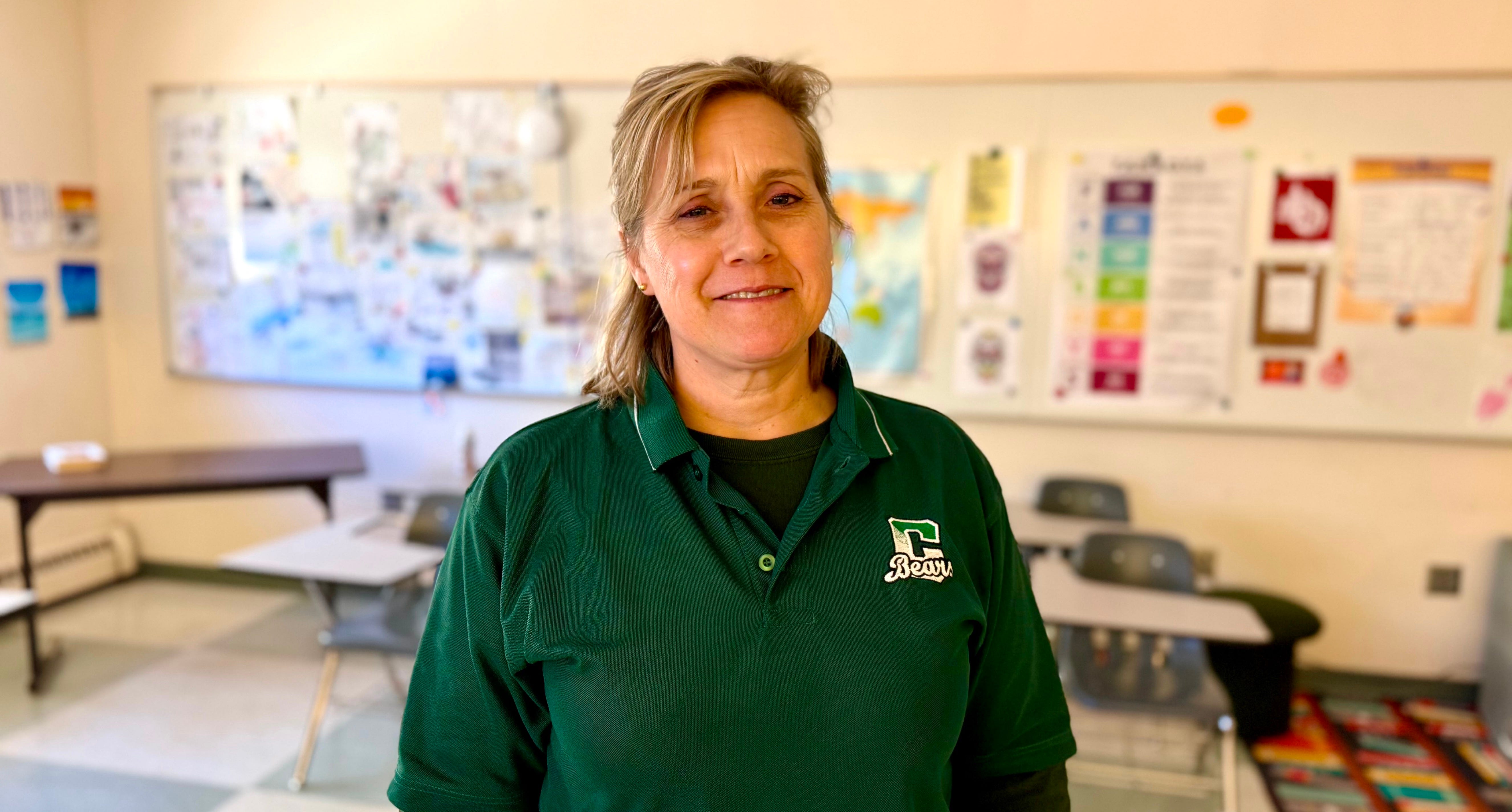
“Mrs. Gillespie was like, A.I. is coming, we need a policy,” said Windey McKelvie, a veteran English teacher at Cloudcroft High School who helped craft the district’s A.I. guidelines. “We put together a committee before the state was even requiring it.”
The committee of high school, middle school, and elementary teachers spent nearly a year on questions now being debated in districts and legislatures nationwide: What is A.I.? When does it help students learn, and when does it get in the way? Who’s responsible when it goes wrong?
The result, adopted by the Cloudcroft Board of Education on Sept. 16, 2025, is two policies: one for employees (Policy EGDA) and one for students (Policy IJNDC). The district’s technology-use regulation and the user agreement that students, parents, and staff sign also reference A.I.
They cover what staff can and can’t feed into tools like ChatGPT or Claude, what students must cite, and who decides whether A.I. is allowed at all: under the student policy, it’s off-limits on an assignment unless a teacher permits it.
The policies say they are “informed by New Mexico Public Education Department guidance, federal principles including the A.I. Bill of Rights, and Cloudcroft Municipal Schools’ existing technology framework.”
The Short Version
Cloudcroft Municipal Schools adopted two A.I. policies on Sept. 16, 2025, one for staff and one for students.
Staff may enter only public information into A.I. tools, and the district has no contracts with any A.I. provider. Students may not use A.I. on an assignment unless a teacher permits it, and they must cite any use.
Teachers set the rules in their own classrooms: high school English teacher Windey McKelvie relies on pen-and-paper work, and the K–8 school is scaling back devices. A.I. training for staff is not mandatory; the district is not evaluating any A.I. tools, and it will review policies at least once a year.
Two high school students describe using A.I. to summarize reading, format essays, write code and clarify sentences. One says the school now encourages A.I.; the other says the rules are a little too strict.
Read on for the full story from students, teachers, administrators and the New Mexico Public Education Department.
What Is Artificial Intelligence?
The term covers a wide spectrum of tools, and understanding the differences matters, McKelvie said, because teachers and parents often conflate them. “I don’t think that everyone is fluent in understanding what A.I. is exactly — like the underpinnings of it, and what the difference is between predictive and generative LLMs.”
The district’s policies define A.I. broadly, as machine-based tools that can “perform tasks typically requiring human intelligence, such as generating text or images, solving problems, creating images, or analyzing data.” They name Magic School, ChatGPT, Google Gemini, Claude, DALL-E and Grammarly as examples.
A.I. Models in School
Predictive text A.I. is built into everyday tools like spellcheck and Grammarly, suggesting the next word or flagging errors. McKelvie said of this tier: “Even that, I think, degrades the necessity of [students] to think for themselves.”
Large Language Models (LLMs), or generative A.I. like ChatGPT, Google Gemini, and Anthropic’s Claude, are trained on vast amounts of text and can produce original-seeming writing, answer complex questions, and summarize documents. Cloudcroft’s policies say they “particularly” cover generative A.I. such as LLMs.
Education-specific A.I. tools, like Magic School A.I., which the district offered teachers during the 2025–26 school year before discontinuing it, run on similar LLM technology wrapped in interfaces built for lesson planning.
A.I. reading assessment tools like AMIRA, the state’s designated reading screener for K–2 students, use voice recognition to listen to students read aloud and score their performance. These are assessment tools, not content generators, a different category than chatbots.
Teacher Discretion
“You can’t put students’ names in. You can’t put any kind of information that’s covered under any kind of protection,” McKelvie said.
The employee policy states that the district has no contracts with any A.I. provider and that “no A.I. tool meets the District’s security, privacy and compliance standards for handling anything besides public data.”
Employees may enter only publicly available information. The policy specifically bars FERPA-protected information, student names and grades, student work, disability-related information, health information, ID photos, and information about employees and their performance.
Acceptable employee uses include general-knowledge questions, brainstorming, summarizing online research, building Excel formulas, and drafting email or letter templates that don’t identify a student or employee.
The policy prohibits using the full text of A.I. output in final work products, or skipping review of it; generating grades, individualized assessments, lesson plans, presentations or IEP determinations without human oversight; and substituting A.I. for professional judgment, “especially in teaching, counseling, or disciplinary decisions.” An IEP, or Individualized Education Program, is a legally binding plan for students who receive special education services.
Employees must also disclose when they use A.I.-generated content, such as in parent communications or reports.
For students, A.I. is off by default.
“Teachers will prohibit the use of A.I. in an assignment unless the use of A.I. is permitted,” the student policy reads.
When a teacher allows it, students may use A.I. for “brainstorming, skill practice, or research support,” must cite it “as is expected with any other source,” and may be asked to explain or revise their work. The policy says students should use A.I. “as a resource and for background material, rather than using the A.I. Tools to complete the assignment,” and it bars “unauthorized or unvetted A.I. platforms on school networks or devices.”
The user agreement that students and parents sign adds that “A.I. tool interactions” are not private and are subject to district monitoring.
The policy also says A.I. detection software “is not a definitive measure of misconduct.” Teachers may use it as a reference but should rely on academic judgment, conferences, and other evidence. “There’s no A.I. tracker that can actually tell you this was 100% A.I.-generated or not,” McKelvie said. “They’re very fallible.”
The district “currently allows teachers professional discretion in determining whether and how A.I. may be used within their classrooms,” Superintendent Jocelyne Gillespie wrote in an email to the Reader. “However, A.I. assistance must not replace, generate, or improperly influence students’ independent work, especially in CORE academic subjects.”
Leveling Up to A.I.-Empowered
McKelvie uses a simple color-coded scale — 0 through 3, red to yellow — for A.I.-free, A.I.-assisted, A.I.-enhanced, and A.I.-empowered work. The labels will soon go up on classroom walls, K–12.
Her AP students write in-class essays by hand, transcribe them into an LLM, prompt it to improve the essay, then compare the two versions. “What did I produce? What did A.I. produce? Was it better? Did A.I. do a better job? Did A.I. pick up things I missed? Like, how can I make my writing better?” she said.
“You can’t freely use it until you have the skill set to use it,” she said. “There are students who are sophisticated enough to know how to use A.I. in a very sophisticated way. That’s another reason things need to be done with pen and paper.”
Some students, she said, feed their own writing into A.I. and ask it to imitate them: “Model my writing. Write something that would look like I wrote it.”
For most assignments, McKelvie assigns in-class, pen-and-paper work. “That’s the only way you can be a hundred percent sure that A.I. hasn’t been used.”
Her students sit AP Literature, AP Language and Composition, and AP Government exams on locked-down, browser-controlled devices, with no A.I. and no spellcheck. “Those students must 100% compose everything by themselves, with spelling, punctuation, and everything coming from their own mind. We’d be doing them a disservice by not having them create things completely from scratch.”
The district’s student policy flags that AP and dual-enrollment courses “may have additional restrictions and limitations regarding the use of A.I.”
McKelvie worries that even ambient A.I., like autocomplete in Google Docs or Grammarly’s suggestions, quietly erodes abilities. “Even though they don’t realize that it’s a passive use of A.I., it’s still involved in what they’re creating.”
“It’s a dangerous crutch to wholly rely on A.I.,” she said. “We can’t just rely on A.I. to do thinking for us.”
K-8: Scaling Back Devices
“We are scaling back the use of digital devices across grades K–8,” said K–8 Principal Nolene Adams. “The state-mandated AMIRA A.I. tool for K–2 is in use, and some early-grade teachers have expressed concerns about its accuracy due to frequent errors.”
Adams said the concerns underscore “the importance of having great foundational teachers.”
Teachers elsewhere in New Mexico have raised similar concerns. Some told the Albuquerque Journal the program struggles with students who have speech disabilities or foreign accents. APS has said it will take at least one full school year to know how Amira’s results line up with state assessments; the state switched from Istation after a corporate merger.
McKelvie ran into the same issue when the district tried to extend AMIRA to her English Language Learner students. “When you have an accent or your English is not the baseline, it’s not a good tool because it can’t differentiate,” she said. “I said it’s not going to work for us.”
In an email response to the Reader’s questions from New Mexico Public Education Department (PED) Communications Bureau Manager Janelle Taylor García, the agency says AMIRA is built on three decades of federally funded research from Carnegie Mellon University, including over 100 peer-reviewed studies, and has been calibrated over two decades to handle accents and dialects, pointing to a demonstration video as evidence. On voice data, PED says AMIRA stores recordings, de-identified, for the duration of the state’s contract; districts can opt out of audio retention locally, and there have been no incidents of student voice data being hacked or misused.
AMIRA, New Mexico’s state-approved A.I. reading screener for K–2, has been required three times a year. In August, PED gave districts the option, for this school year only, to use it without its voice-recording feature or to substitute a paper test or their own assessment.
Middle School: “Go Slow to Go Fast”
At Cloudcroft Middle School, Serena Myers teaches computer science and computer applications. “For 6th grade it’s keyboarding basics,” she said. She focuses on building comfort with Google Workspace’s most common apps. From there, instruction moves to fundamentals: “just getting an understanding [of] what computer science is and the world that we live in. We’re in a tech era.”
“Cloudcroft Municipal Schools is requiring students to take a semester of computer science to better prepare them for high school and build foundational skills,” Myers said. The requirement applies to eighth graders.
A.I. is already built into tools students use daily — Code.org (now Code A.I.), Project Lead the Way, Samsung’s Bixby, Apple’s Siri, Google’s Gemini and Copilot. When students turn to a browser’s built-in assistant for research, Myers pushes them to verify it. “I always ask, OK, so what are the three sources to prove that it is reliable — because there are more hoax sites than there are authentic.”
On the content-monitoring software the district uses on school networks, GoGuardian, she said: “I’m pro that. More than anything, it’s just to let them know — you don’t know what you don’t know. Students test their boundaries in the classroom. They’re gonna test it online too.”
District regulation requires content filtering on school networks and says internet use through district systems “shall be monitored periodically or randomly.”
She compares A.I. to the early days of school internet access, when it took years to build a knowledge base to use it well. “It needs to be a gradual release — go slow to go fast, not get shoved.”
“We have learned during the shutdown that continuous use of devices and increased screen time has hindered learning,” Myers said. “Attention span has shortened, and we are in the study stages of what is developmentally appropriate.”
On the district’s pace overall: “I give full kudos to Cloudcroft that they are forward-thinking when things happen ... it shows some grace, allowing some time so we can absorb and practice before we go all in. It’s a wise move.”
And on her students: “My jewels are showing open, inquisitive minds, challenging me to be present and the best for them.”
The Student View: “There’s a Need for a Balance”
Michael Anthony is 16, a junior at Cloudcroft High School, and a chapter officer in the school’s Technology Student Association. He has competed in TSA’s video game design event for three years. This spring, at the state conference in Las Cruces, he’ll try something new: an A.I. event the organization added this year.
He doesn’t know yet what he’ll be asked to make. Competitors get their prompts on site.
“It’s a brand-new event they just recently added, but from the event guide that I’ve read, they’re going to give you something they want you to create,” he said over the phone. “And then you have to use your selected A.I. and create a prompt, or generate an image of what they want. And whoever gets the closest gets the most points and does well in the event.”
“Sometimes if it’s a lot of reading — because I’m not very good at reading, I’m mildly dyslexic — I copy and paste the notes into Gemini or ChatGPT and just have it summarize the important information that I need,” Anthony said. “I think it’s very useful to have that kind of thing right there, where it’s less words to have to read, but also the same information.”
“It really does help,” he said.
“I think they have a pretty decent amount of it, because they can’t really stop kids from using A.I.,” he said. “So I think they more encourage it here now. They’re not saying, ‘Oh, you can’t use ChatGPT.’ One of my teachers last year told me, ‘Just don’t use A.I. to write your essay. Use it to assist you in writing your essay.’”
“I write down most of the information I want,” he said, “but if I’m confused on how to make MLA format — like I did with an essay recently — I was like, ‘Can you make this in MLA format for me?’ And it did that really quickly.”
“I think there’s maybe one or two that would have an issue with it,” he said, “but I don’t think many teachers have an issue with it.”
Neither of the district’s A.I. policies addresses using A.I. as an accommodation for students with learning differences like dyslexia. The employee policy says A.I. “has the potential to support personalized learning and help teachers identify areas where students need extra support,” but neither policy says how A.I. fits with IEP or 504 accommodations.
“I’m not very good at art — I really suck at it — but I have these crazy visions, these crazy stories,” he said. “On my Instagram I have this A.I. picture of a suit of armor kind of thing. I didn’t know how to design it, so I was having A.I. generate some concepts for it. And I found one that I really liked.”


“I’m a really big fan of Copilot for video game design,” he said. “I’m using it a lot to help me code things I don’t know how to understand. I can code pretty well, but I don’t know everything, and it really helps me to understand how to do that kind of coding.”
“Google’s very specific, but I can go up to ChatGPT, like, ‘What are the results for this game?’” he said. “And they’ll tell me the results for the game.”
“I feel pretty prepared to have A.I. in my future,” he said.
His grandmother recently assumed something she saw had been made with A.I.
“It’s so ingrained now that people are thinking it’s in everything, but it’s not,” he said. “And there’s also a balance of how people abuse it — just use it for everything — and how people use it to assist. I know someone who used A.I. to write an entire essay just recently, and I’ve used it just to help me write a few topics or think about certain ideas. There’s a need for a balance.”
“We had a whole discussion about this in AP Lang the other day,” he said. “When you’re having A.I. generate your entire thing for you, you’re not gaining that critical thinking experience, and you’re not gaining the ability to think and grow and learn how to write yourself. You’re just having ChatGPT do all that for you, and you’re not developing those skills. But if you’re actually writing it and thinking about it, you’re developing those skills — and just having A.I. come in and help you if you can’t think of a problem like that.”
N. B., another Cloudcroft High School student, identified by his initials to protect his privacy, answered the Reader’s questions by email.
“I sometimes use A.I. to clarify what a sentence is saying if I do not understand a sentence and I am like at home doing school work, but otherwise I don’t really use A.I. at all,” he wrote, “because even if you use it to clarify or make your work better, you can still get docked for plagiarism.”
“I feel like the school is a little too strict about the A.I. policy, because if you only use it to make your work better but not use it to complete it, you should not be docked for it unless you use it for over half of your work.”
The student policy treats A.I.-generated content submitted “as original work without permission or disclosure” as plagiarism, with consequences that can include revising the assignment or losing credit. It also puts the burden on students to ask their teacher whether A.I. is allowed on an assignment, and to what extent.
“I feel slightly prepared for a future with A.I., but I feel like people will use it too much just to do all of the work for them instead of doing it themselves,” N.B. wrote. “I feel like A.I. can be used for good, but if you use it wrong it can be bad and could possibly make you lazy from doing it.”
“I feel like in the future it could possibly also stop listening,” he wrote, “because it is all about the info you feed it, and if you feed it the wrong information it could take over, not listen to you and possibly even hack off of your devices and stuff.”
How Cloudcroft Compares
PED doesn’t currently track which districts have adopted formal A.I. policies, so no statewide comparison is available.
A New Mexico Legislative Education Study Committee working group recommended in July 2025 that PED establish an oversight body to vet A.I. tools and help schools find funding, noting that “A.I. is moving faster than our systems can keep up.” PED Secretary Mariana D. Padilla framed the state’s vision this way: “A.I. can enrich the learning experience, but it is human oversight, inquiry, and reflection that ultimately drive meaningful education.”
At the state level, there’s no funding earmarked for A.I. professional development — districts allocate existing training budgets at their discretion. What the state offers is free A.I. literacy training through Canvas, its statewide learning management system, plus a procurement toolkit to help schools vet tools. Janelle Taylor García wrote in her email that the agency’s role is less about mandating policy and more about equipping districts to make their own decisions, and that funding for professional development remains a local call.
“At this time, Cloudcroft Municipal Schools has not established mandatory artificial intelligence (A.I.) professional development for all staff,” Gillespie wrote in response to a Reader inquiry over email.
Instead, teachers take up A.I. in Professional Learning Communities, or PLCs, during regularly scheduled meetings. There they discuss its “potential benefits and concerns” and share training available through PED and other organizations. The employee policy says the district “will provide professional development and guidance” on ethical use, bias and misinformation, and the secure use of district-approved tools.
On tools, “Currently, the District is not evaluating any A.I. tools for teachers,” Gillespie wrote. The district used Magic School A.I. during the 2025–26 school year; “however, the majority of our teachers did not use it.” Instead, she wrote, “Teachers are utilizing A.I. tools they are comfortable using and sharing their knowledge with colleagues.” The employee policy, meanwhile, says no A.I. tool meets the district’s standards for handling anything but public data.
Both policies also refer to approved A.I. tools, and the student policy says “efforts will be made to provide all students with access to approved A.I. technologies.”
Gillespie said the district will review its A.I. guidelines at least annually, “with additional evaluations as significant technological advancements, state guidance, or legal requirements emerge,” through PLC discussions and administrative review.
“Artificial intelligence is advancing at an extraordinary pace—moving almost like a speeding bullet—and school districts across the nation are struggling to keep policies, instructional practices, and professional development aligned with rapidly changing technology,” she wrote.
“Rather than resist its advancement, our District is committed to being responsible stewards of this technology, embracing its potential while teaching students to use A.I. ethically, responsibly, and with integrity. Our goal is to prepare students for an A.I.-driven future without compromising the critical thinking, creativity, and independent learning essential to their success,” she wrote.
The Water Bottle Moment
McKelvie was demonstrating A.I. to her students by asking it to generate something silly involving a vocabulary word when a student stopped her. “One of my students said, ‘You just wasted 20 bottles of water doing that.’”
“I actually was thinking, wow, you know what, you’re right,” McKelvie said. “There’s a consequence for playing around with it. It’s not just for fun. There are real-world ramifications behind using A.I. indiscriminately.”
A student raising environmental concerns unprompted says something about the A.I. literacy already developing in Cloudcroft’s classrooms.
“I have not talked to any educators who are like, no one should be using A.I., it’s a terrible thing,” McKelvie said. “Educators understand that it’s here. Like, what do you do? You can’t shut the box again.”
This original reporting drew on the Cloudcroft Schools’ A.I. policies, multiple in-person and phone interviews, texts, and emails with Cloudcroft Schools and NMPED employees, administrators, and students, as well as independent research. It is A.I.-empowered through automatic interview recording transcription, grammar and editing help, and research.
More Technology Reporting on Cloudcroft Schools:
Cloudcroft Middle School saw a sharp rise in academic proficiency after locking away phones. Educators and researchers are watching to see if the results can be replicated statewide.

Reports like this are made possible by the support of great companies like Noisy Water Winery:

Promote Your Business
Learn about sponsorship opportunities for your business in support of the Reader. Contact us for more information at sponsorship-info@cloudcroftreader.com
Cloudcroft Reader is proud to be sponsored in part by great companies like:
Cloudcroft Art Society
Located in Old Red Brick Schoolhouse: Holiday and Saturday art showsNoisy Water Winery
Family-owned winery crafting thoughtfully made wines from New Mexico grapes, inspired by mountain living.Be in the Mountains Yoga & Massage
A cozy space for yoga and massage therapy at the Village PlazaThe Stove and Spa Store
We offer a variety of services to ensure your hearth and spa dreams are met!The Lodge at Cloudcroft
Landmark Choice Among New Mexico ResortsHomee
Real Estate Property Management and RentalsCloudcroft Art Workshops
Enhance your artistry while enjoying the beauty and coolness of the mountains!Sacramento Camp & Conference Center
Come to the Mountain — Let God Refresh Your SoulLaughing Leaf Dispensary
Discover a world of wellness at Laughing LeafInstant Karma
Adventure Within: Transformative Yoga, Ayurvedic Wisdom, Nourishing Organics, Fair Trade BoutiqueOff the Beaten Path
Eclectic gifts & original artworkFuture Real Estate
Raise your expectations.Ski Cloudcroft
The Southernmost ski area in New Mexico.Cloudcroft Therapeutic Massage
Maximizing Movement, Quality of Life ImprovementHigh Altitude
Your favorite little outdoor outfitter on Burro AvenueBlushing Yucca Esthetics
✨ Book your glow-up today✨The Elk Shed
Purveyors of Southwest + Mountain Provisions, Goods & FineryThe PAC
Pickleball Addicts of Cloudcroft—Pickleball in the CloudsBre Hope Media
Professional photo and video servicesDiscover Cloudcroft
Plan your visit to New Mexico’s Mountain Getaway
And readers like you. Will you support our work?