


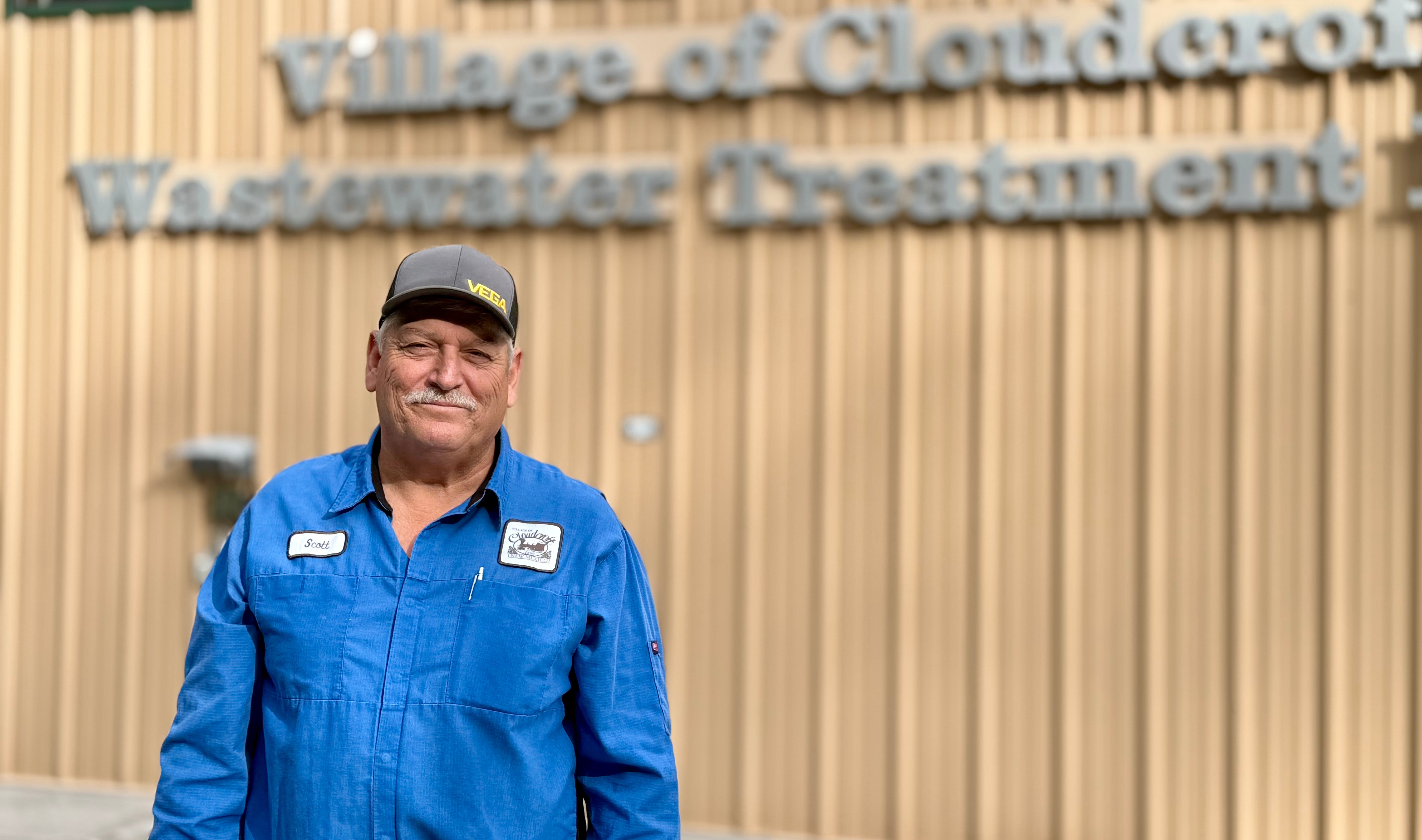
Scott Powell is waiting for me at the Wastewater Treatment Plant at 5 a.m., and shines a flashlight to light the steep driveway at the forested canyon site across the road from the Osha Trail parking lot.
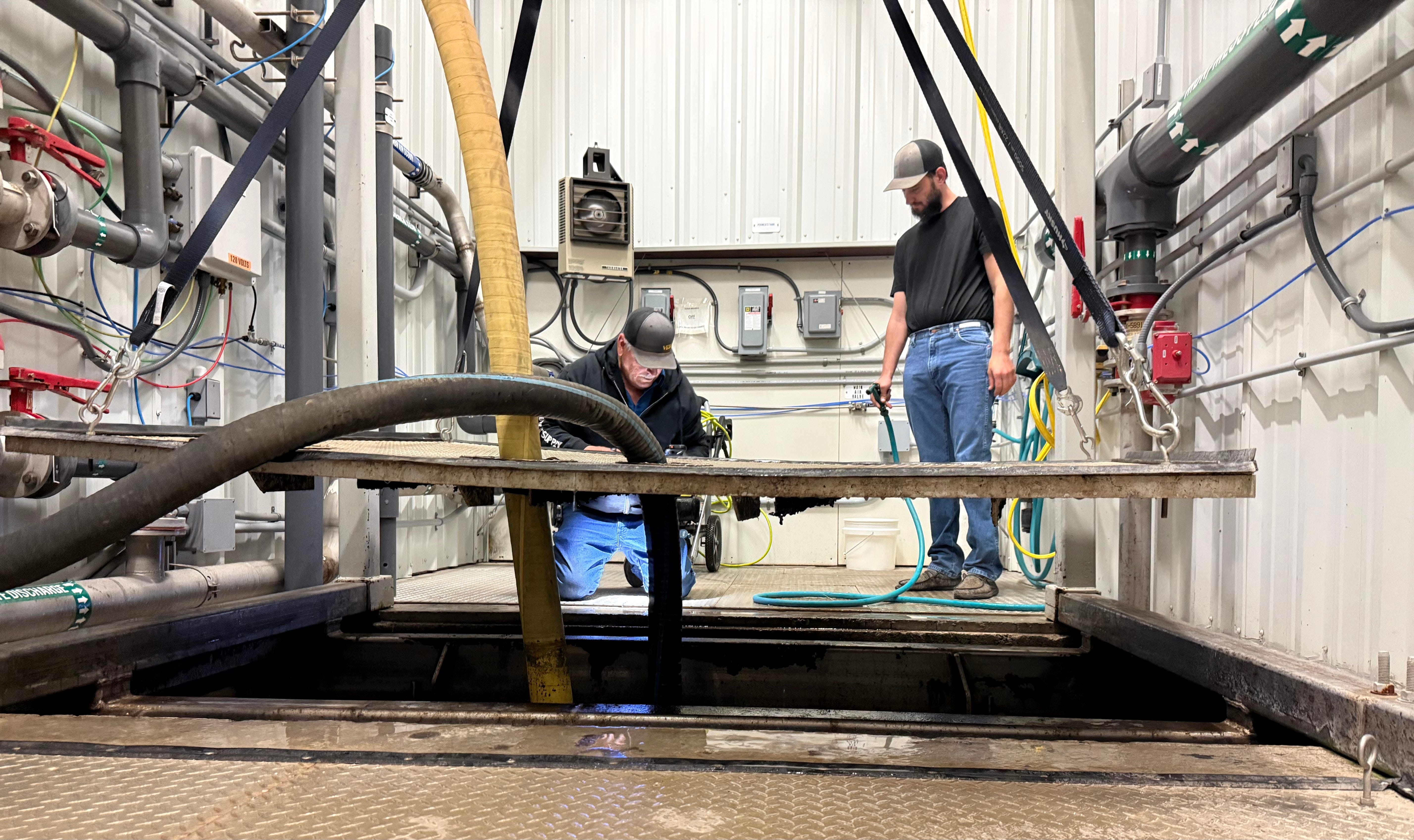
While most of the village is asleep, Powell starts his annual recovery cleaning of the Wastewater Treatment Plant Membrane Bioreactor (MBR) filters.
Within a few minutes, he’s crouching over a tank explaining the finer points of membrane fiber maintenance, unbothered as a man tending a garden. His one sticking point—supposedly “flushable” wipes that gum up the works—he urges folks not to flush them.
Powell has run the Village of Cloudcroft’s wastewater treatment plant for more than three decades. He knows where every pipe goes, which pump sounds slightly off, and why the Italian-designed system uses red lights to mean “running” and green to mean “stop.”
“That took a little bit to get used to,” he says.
It’s one of many peculiar things at this aging plant that he’s had to figure out on his own.
When Powell retires in December, all his institutional knowledge goes with him—so he’s left detailed notes behind in spreadsheets and countless handwritten notebooks for those who come next.
Where He Started
Powell grew up in La Luz. “I didn’t care much for school,” he grins.
When he graduated in 1979, he went to work at Alamo Piping Supply across from the fairgrounds, learning what fittings were and how “crap runs downhill,” he chuckles.
From there: Ponderosa Plumbing, then a year and a half with Statewide Drilling, a well-drilling outfit. He arrived at the Village of Cloudcroft in May 1994.
For years, he coached youth baseball through the Sacramento Mountain Sports Association, running teams for boys and girls on the fields at what is now Elevation Park. Powell remembers coaching Chris Davis, who now coaches a new generation of players at the same field.
Powell ran both the water and wastewater systems for the village for nearly 19 years. “It just got too overwhelming,” he says. Eventually, the systems were split. He took wastewater. He has been here ever since.
Powell holds a Level 4 certification — the highest available in New Mexico for wastewater operators. He got there faster than most because he arrived with plumbing and well-drilling already under his belt.
“Somebody fresh — (it can take) at least a good five years to really get up to about level three or so, maybe four years if they have really good experience,” he says.
Robert George, a technical assistance provider contracted by the New Mexico Environment Department who has known Powell for over 30 years, told village leaders at a December 2025 workshop: “It’s very, very hard to find replacements for highly licensed operators. You’re going to have to grow your own.”
When Powell retires, Public Works Supervisor J.J. Carrizal has the right license to keep things running while Wastewater employee Sean O’Connor works towards upper-level certifications. He takes his level one tests this month.
The Plant
Cloudcroft’s treatment plant operates two systems. A trickling filter system, now pushing 70 years old, handles the majority of the flow. Above it stands a membrane bioreactor plant — the MBR — installed in 2017 and brought online in 2018. Powell knows both systems like the back of his hand.
No operations manual was ever written for the MBR.
The company that designed and built it was supposed to provide one.
“To this day, they were supposed to be giving us more,” Powell says. “Supposed to give us training. We didn’t get that either.”
What Cloudcroft got instead was Powell. He called other operators around the state with similar equipment. He looked things up. He keeps notebooks — two spiral-bound ones for the annual recovery cleanings alone — and started building maintenance spreadsheets about four or five years ago, once he “finally figured out how to make them.”
“Unfortunately, I didn’t start those years ago,” he says. “But I try to write everything. Something comes up two years from now, you may have to look through the book.”
The notebooks document what went wrong, how he fixed it, and how long each step took.
“I try to write whatever I did to fix it.”
“The whole idea with these ‘cleans’ is to preserve them. Make them last as long as you can.” — Scott Powell
Every spring, Powell runs what the system calls a recovery cleaning — an eight-hour chemical soak of the membranes, using hypochlorite to strip accumulated organics and citric acid to dissolve mineral scale. Cloudcroft’s water is hard. The citric solution is 38 percent concentrated, “but everyone calls it 40.”
The week is scheduled precisely: MBR number one gets hypochlorite on day one, citric on day two. Then MBR number two follows the same sequence. One reactor at a time, because you can’t take both offline simultaneously.
The entire cleaning process is designed to extend the life of the membrane cassettes, which the manufacturer rates at about 10 years. Powell thinks these will go 12, “maybe 13 or 14, because Cloudcroft doesn’t take industrial waste. It’s residential discharge and a few restaurants.”
During the soak, the Supervisory Control and Data Acquisition (SCADA) system guides the operator through each step. It is, Powell says, “pretty good about walking you along.”
It wasn’t always like this. The original plant — the trickling filter — was entirely hands-on. No computer, no automation. “That was kind of neat, but it wasn’t ideal,” he says.
The trickling filter, for all its age, still works. George called it “remarkably good treatment” for organics and solids at the December workshop.
The state’s draft groundwater discharge permit, stalled since March 2024, would require total nitrogen in the plant’s effluent to drop to 10 milligrams per liter. The plant currently runs at roughly five times that.
Cloudcroft has operated without an active discharge permit since the EPA withdrew federal authorization in 2017. George called that “pretty unusual” for a facility of its size.
The MBR, properly tuned, has produced results under 10 mg/L in testing. But Powell noted the readings lately had been “bouncing between 10 and 15, 16 milligrams.” Right now, the MBR handles about 20,000 to 30,000 gallons per day of the flow. Everything else moves through the old trickling filter.
The plant processes between 40,000 and nearly 230,000 gallons daily, depending on Cloudcroft's population during peak tourist season.
Powell has watched the old infrastructure wear down piece by piece. The secondary clarifier, the filter beds, the pumps — things go bad, and getting parts isn’t what it used to be.
“Hard to find parts nowadays,” he says. The plant was built in an era when you could call a supplier and get what you needed the same week. Some replacement parts are custom-built, an expensive and time-consuming process.
Powell ticks off the upcoming budget priorities: “Definitely that generator. Still, the sludge handling. Trying to get repairs done on this old setup that’s falling apart. Just got a few pumps. And we’re trying to upgrade our SCADA system.”
Cloudcroft (Water) Bears
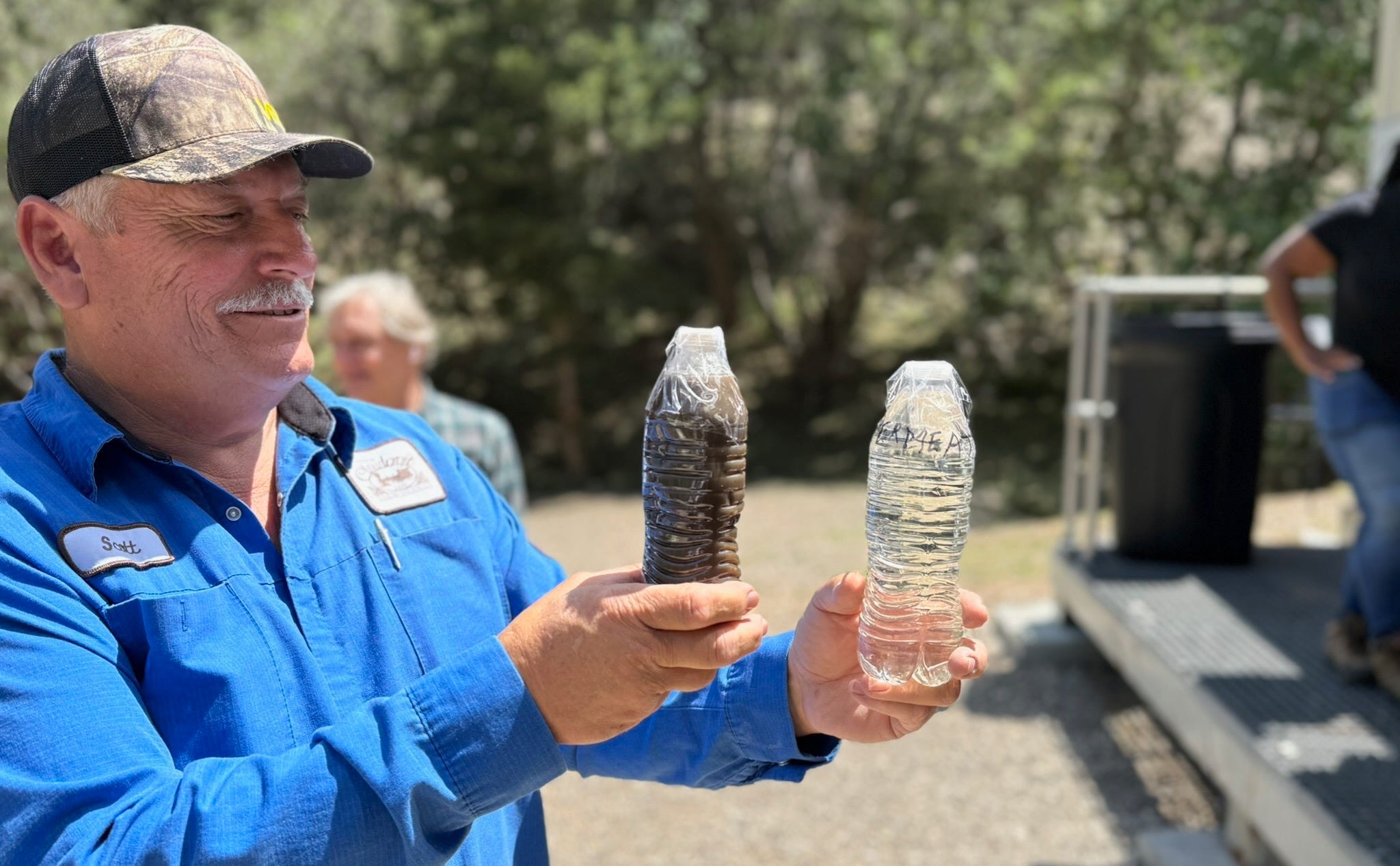
The biological heart of the plant lives in the activated sludge — a community of microorganisms that do the actual work of breaking down organic waste. Powell checks on them with a microscope when “something seems off.”
“Whenever it looks like something in the plant’s acting up,” he says. “I’ve been down there a couple of times in the wintertime just because it’s cold. Seeing that everything’s still alive.”
After the recovery cleaning, the chemical-soaking water is pumped out and hauled away, then returned to the sewer system at the Chataqua Lift Station. This prevents microorganisms from experiencing a shock.
The organisms behave, he says, like people.
“Summertime, it’s hot. They’re more active. In the wintertime when it’s cold, they’re more dormant. The younger ones are out playing, running around, and active. The older ones are just sitting there doing nothing and eating. And of course, when they get old and wore out, they die off, just like we do.”
On a healthy summer microscope slide, he might see hundreds of organisms in a single drop — sometimes so many he has to move the slide around to count. On a winter slide, maybe 20.
Among the more striking inhabitants are tardigrades — microscopic animals known as water bears — creatures less than a millimeter long that are among the most resilient animals on Earth. In wastewater treatment, their presence signals a mature, stable sludge community.
“Water bears are good signs. Good sludge.”
Under the microscope, he says, you can watch them eat. See the food moving up through the body. They look, he says, just like a bear walking.
He has been trying for years to find a projector that would throw the microscope image onto a screen large enough for a classroom. The plant has hosted school tours over the years.
“That’s when people really get it,” he says. “I’m always happy to kind of teach them. Be it a kid or an old person or a councilman — just anybody. The more people that understand, the better.”


No Manual, No Permit, No Land
The consequences of inaction aren’t abstract — inadequately treated water running down the canyon can trigger state fines. Carrizal recently told the Reader that the fines can quickly amass.
In a November 2022 meeting, Carrizal warned the village that it "will result in fines if, during power outages, the Village has to let untreated wastewater run down the adjacent canyon." The problems flow downhill, literally, with neighboring communities like High Rolls Mountain Park less than five miles away.
The plant sits on U.S. Forest Service land. The village has been working since at least 2015 to either lease or purchase the property, because without clear land tenure, no lender or state regulator will finance major upgrades.
“That’s part of the reason why we weren’t getting grants,” Powell says. “Because we didn’t own the land.”
It is one of several linked problems that have made it hard to move forward. No permit. Aging infrastructure. No land rights. Millions of dollars needed for whatever comes next — whether that’s additional MBR cassettes, a new sequential batch reactor, or some other configuration an engineer recommends. George repeatedly stressed the need for a full preliminary engineering report before the village commits to any new path for the plant.
Powell has watched versions of this loop play out across most of his career; years when things were moving, years when things were put on hold. He waited. He kept the old plant running.
“I’m kind of down here in my own world,” Powell says, seated in the small windowless control room. “(The council) always left me alone. I knew what I was doing. If I’ve got problems, I’d come let you know.”
“At least you’ll understand what you’re voting on and what your money needs to go to. Come down here. I’ll show you around.”
Powell also consults, in his off-hours, for seven small water systems scattered across the Sacramento Mountains — Silver Cloud, Aspendale Baptist Camp, and others. He performs weekly checks on some, biweekly on others.
“They all basically have the same problems,” he says. “Water breaks. They don’t know where it is. Can’t find them. Takes months or years.”
In retirement, he says, he’ll keep those contracts and look for a couple more. And, he’ll have more time to fish.
His successor, Sean O’Connor, is taking the Level 1 test this spring.
George, at the December workshop, urged village leaders to start planning for this transition now. “Figure out who his successor is going to be,” he said. “Let him do his best to train that person while he’s still on staff.”
There is also the question of what doesn’t get written down — the knowledge that lives in Powell’s hands and his memory. How the plant sounds on a normal day. Which alarm can wait and which one means get there now. What combination of adjustments brings a struggling system back into range; thirty-one years of that.
“That’s the interesting part of the whole process,” he says, meaning the bugs, the biology, the fact that clean water comes out the other end of a system that looks, to most people, like it shouldn’t work at all. “I mean, a lot of people don’t like wastewater. But a lot of people do. And it’s like, well, come down and see it.”
He’ll be here until December.
The Reader is proud to be sponsored in part by great companies like PVT:

Cloudcroft Reader is proud to be sponsored in part by great companies like:
Cloudcroft Art Workshops
Enhance your artistry while enjoying the beauty and coolness of the mountains!Noisy Water Winery
Family-owned winery crafting thoughtfully made wines from New Mexico grapes, inspired by mountain living.Be in the Mountains Yoga & Massage
A cozy space for yoga and massage therapy at the Village PlazaOsha Trail Depot
Your destination for unique, hand-crafted treasuresThe Stove and Spa Store
We offer a variety of services to ensure your hearth and spa dreams are met!The Lodge at Cloudcroft
Landmark Choice Among New Mexico ResortsSacramento Camp & Conference Center
Come to the Mountain — Let God Refresh Your SoulLaughing Leaf Dispensary
Discover a world of wellness at Laughing LeafInstant Karma
Adventure Within: Transformative Yoga, Ayurvedic Wisdom, Nourishing Organics, Fair Trade BoutiqueOff the Beaten Path
Eclectic gifts & original artworkFuture Real Estate
Raise your expectations.Ski Cloudcroft
The Southernmost ski area in New Mexico.Cloudcroft Therapeutic Massage
Maximizing Movement, Quality of Life ImprovementHigh Altitude
Your favorite little outdoor outfitter on Burro AvenueBlushing Yucca Esthetics
✨ Book your glow-up today✨The Elk Shed
Purveyors of Southwest + Mountain Provisions, Goods & FineryThe PAC
Pickleball Addicts of Cloudcroft—Pickleball in the CloudsPeñasco Valley Telephone Cooperative
For all the ways you love to connectBre Hope Media
Professional photo and video services


Thanks for reading. Subscribe for free articles and newsletters just like this, direct to your inbox.