


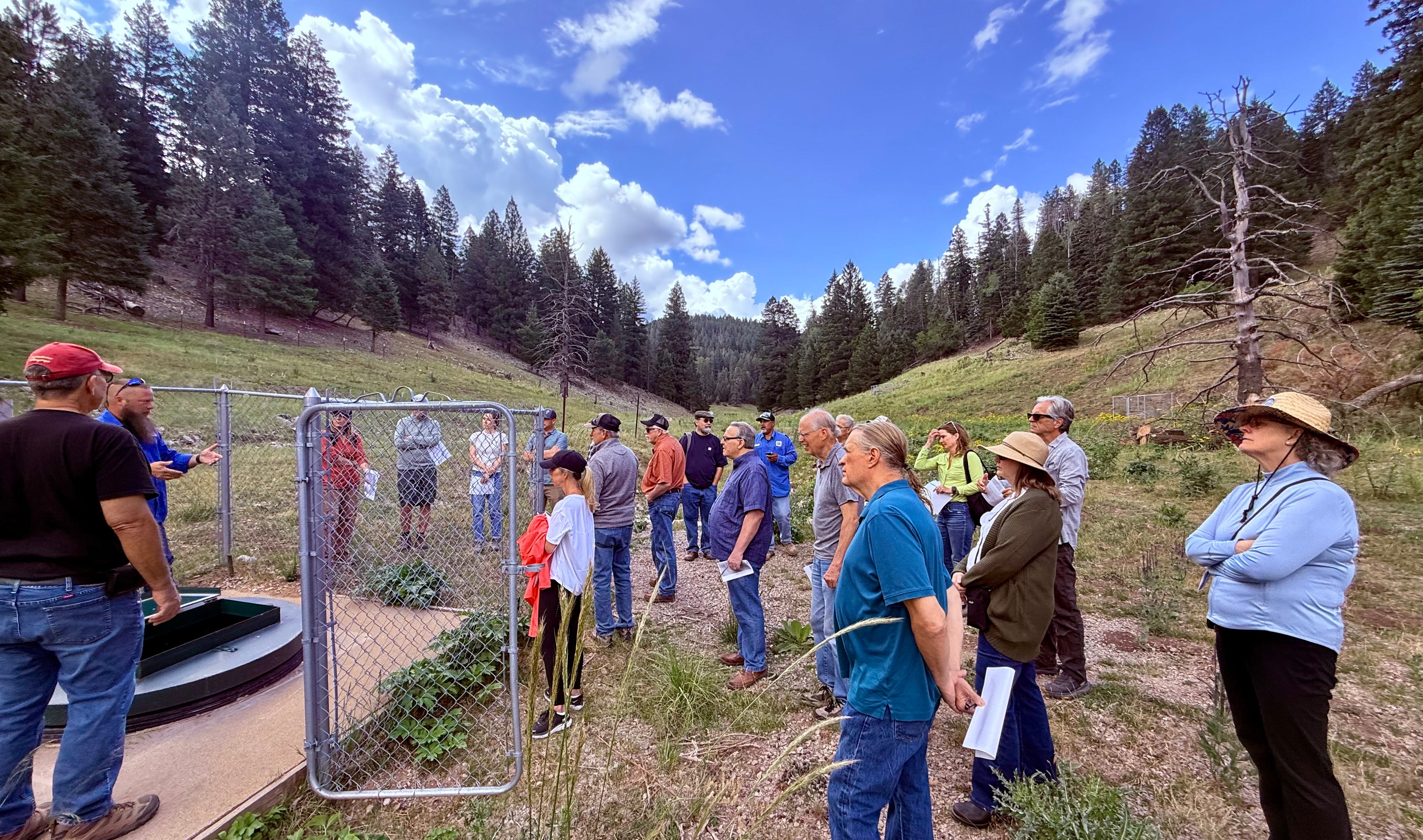
Village Water Operator David Hunter walked this year’s Leadership Cloudcroft cohort through the water systems near Ski Cloudcroft on July 17. What they learned: the water coming out of your faucet right now has likely been working its way down through the mountain for 15 to 25 years, according to isotope dating from the New Mexico Bureau of Geology and Mineral Resources.
Testing using chemical and oxygen-isotope analysis confirmed that snowmelt, rather than rainfall, is the primary source of reservoir refill in the area.
Some of that same snowmelt, moving on eastward toward the Roswell Artesian Basin, won’t resurface for roughly 1,300 years, according to that same NM Bureau of Geology study.
Hunter, a Level IV-certified operator five months into the job, led the cohort, plus a handful of retired engineers, geophysicists, local leaders, and village officials who tagged along, through the wells, springs, tanks, and pump stations that keep Cloudcroft running.
Public Works hosted; Ski Cloudcroft donated lunch. Incoming weather cut the day short, and the group wrapped up the conversation over lunch instead of finishing a planned stop at the Hilltop Tank.
Here’s what stood out, starting with the system’s most pressing weak point.
Little Room for Leaks
Hunter’s biggest worry isn’t a shortage of water underground; it’s a shortage of places to put it above ground once it’s pumped.
Under normal operation, the village’s single raw water tank drops to around 8 feet after the system’s other tanks fill for the day. That’s routine.
But earlier this year, a major leak forced the wells to run nearly around the clock for about six weeks, and during that stretch, the raw water tank came dangerously close to draining completely, a very different, much more serious low point.
If system pressure drops below 20 psi, the New Mexico Environment Department's Drinking Water Bureau considers the system vulnerable to contamination seeping through cracks and joints and would issue a boil advisory.
Public Works proposed a fix as part of the village’s recent infrastructure capital improvement plan request: a second tank, matched to the existing 500,000-gallon raw water tank and tied in so that both fill and draw down together, roughly doubling storage. Based on estimates from Public Works Supervisor JJ Carrizal, Mayor Dusty Wiley, and Trustee Keith Hamilton, the project’s price tag was between $1.5 to $2 million.
Water (Time) Tables
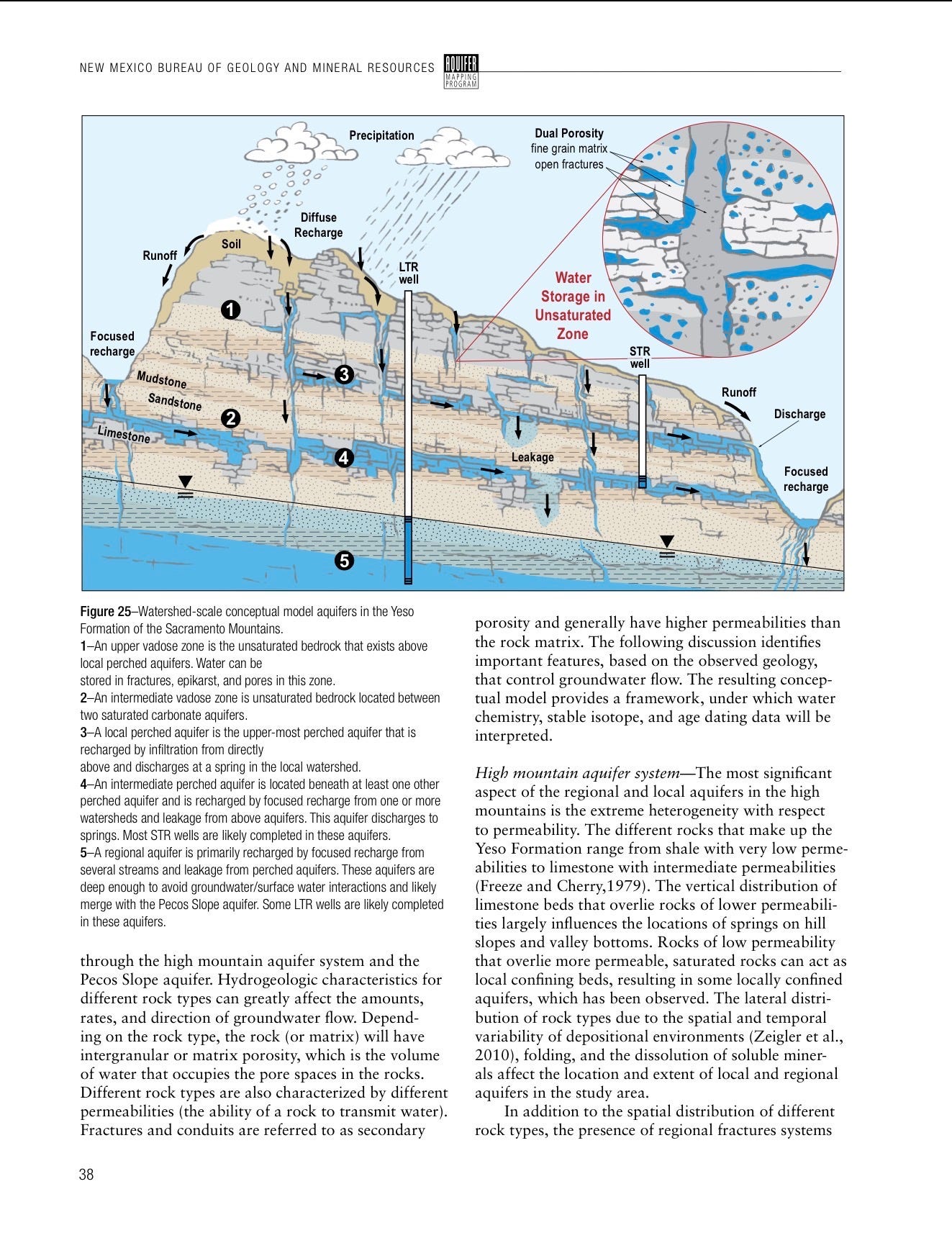
The mountain is composed of a fractured carbonate reservoir consisting of dolomite and limestone. This is a critical distinction because such reservoirs exhibit “chaotic” behavior compared to a standard sand-based aquifer.
Snowmelt has historically been the dominant recharge source, according to the Southern Sacramento Mountains Hydrogeology Study, a multi-year investigation by the New Mexico Bureau of Geology and Mineral Resources (data collected 2005–2009). Extreme monsoon events, more than about 7 inches of rain in a few days, matter too.
“A lot of people that I’ve met and talked to think that if I take a cup of water and pour it out on the ground, in about a week it’s going to be back in the aquifer,” Hunter said. “It takes years.”
Cloudcroft’s altitude is part of what makes this matter.
The Bureau’s study found that roughly 75% of all recharge to the regional aquifer system happens above 7,800 feet in elevation, and Cloudcroft itself sits at 8,575 feet, according to a 1960 U.S. Geological Survey report on the area’s groundwater. The village isn’t just managing its own water supply; it’s sitting inside the primary recharge zone for a system that ultimately feeds the Roswell Artesian Basin, dozens of miles to the east.
The mechanics behind Hunter’s “three different tables” theory line up with the geology on record, too. Per the 1960 USGS report, the San Andres limestone that caps the mountain is cavernous and acts as a recharge conduit, feeding water down into the Yeso formation below, a 1,200- to 1,800-foot-thick layer of limestone, gypsum, shale, and siltstone that forms the area’s real aquifer.
Water moving down through the Yeso hits the first impermeable shale or siltstone layer it can’t pass through, then travels sideways along the top of that layer until it finds a way out, through a spring.
Different wells hitting different impermeable layers at different depths would produce exactly the pattern Hunter described: wells at similar elevations with noticeably different depths, suggesting they’re not all drawing from the same water table.
One practical takeaway: Slowing rainwater runoff upstream through gabions, retained tree cover, or other buffers has been shown to help rainfall recharge that does seep into the fractured rock rather than run off.
It won’t replace snowmelt as the primary source, but it’s one lever available now.
More Possible Solutions on the Table
Beyond the second storage tank, several other ideas surfaced during the tour. All in progress, proposed, or under discussion:
A formal aquifer connectivity study in Pump House Canyon: A neighboring resident’s well is known to drop when the village’s wells run, pointing to at least partial connectivity between sources, but the village hasn’t formally studied which wells actually share water. That kind of assessment came up as a potentially cheaper alternative to the other option on the table: drilling a new well on water rights the village already holds off Highway 244, which would require a new pipeline and possibly a pump to push water back uphill.
A new supervisory control and data acquisition system, currently out to bid: The upgrade is expected to add automatic level readings for tanks and ponds. Right now, Hunter measures pond depth by hand with a tape measure, plus new chlorine monitoring equipment and a cybersecurity component.
An ongoing valve exercise program: Public Works has been locating, logging, and testing valves throughout the system. Several have turned out to be non-functional, requiring whole- or partial-town shutdowns to replace them.
A redesigned chlorine injection line: swapping steel-and-brass fittings for PVC to make future repairs easier.
Solar panels redirected to power the pump building: Recently connected to power the pumps, the village hasn’t yet tracked a full month of savings, though it’s estimated to be in the thousands. The project has already eliminated a specific transformer and meter fee, resulting in immediate savings of $500 per month, regardless of energy production.
In a June 2012 preliminary report on the Sacramento Mountains Watershed, researchers questioned whether tree thinning could increase the region’s water resources.
In an October 2015 open-file report for the NM Bureau of Geology, researchers found that tree thinning in the recharge area has been most effective at higher elevations, particularly when larger trees are present, and in areas with north- or northeast-sloping topography.
Research in this area is ongoing because tree thinning is costly.
What it Means for Villagers
Since a major leak was repaired this winter, the system has stabilized: the Woodlands tank now needs refilling every three to four days and the Hilltop tank roughly once a day, down from continuous well operation during the leak.
Wells now run an estimated three to four hours a day.
If there were ever a problem, like a failed sample, Hunter said, water under a boil advisory would take at least a day to reach the public, given how long water sits in the system before it’s distributed. The water plant, wells, and springs are nearly a mile away from the Hilltop tank.
Groundwater in Cloudcroft only requires chlorination, not the filtration required for surface water. That’s not just a regulatory quirk: the 1960 USGS report found the area’s groundwater lightly mineralized, a byproduct of the water’s short travel time and the limestone it naturally filters through on its way down.
Hunter said the current well and spring supply looks solid, for now.


This article was written based on an in-person visit to the village’s wells and springs, independent research, interviews with Water Operator David Hunter, and a transcript of the Leadership Cloudcroft tour. This report was reviewed by experts before publication.
Hydrology reports and studies are available at no cost to the public at: https://geoinfo.nmt.edu/publications/
Cloudcroft Reader is proud to be sponsored in part by great companies like Laughing Leaf:

Cloudcroft Art Society
Located in Old Red Brick Schoolhouse: Holiday and Saturday art showsNoisy Water Winery
Family-owned winery crafting thoughtfully made wines from New Mexico grapes, inspired by mountain living.Be in the Mountains Yoga & Massage
A cozy space for yoga and massage therapy at the Village PlazaOsha Trail Depot
Your destination for unique, hand-crafted treasuresThe Stove and Spa Store
We offer a variety of services to ensure your hearth and spa dreams are met!The Lodge at Cloudcroft
Landmark Choice Among New Mexico ResortsCloudcroft Art Workshops
Enhance your artistry while enjoying the beauty and coolness of the mountains!Sacramento Camp & Conference Center
Come to the Mountain — Let God Refresh Your SoulLaughing Leaf Dispensary
Discover a world of wellness at Laughing LeafInstant Karma
Adventure Within: Transformative Yoga, Ayurvedic Wisdom, Nourishing Organics, Fair Trade BoutiqueOff the Beaten Path
Eclectic gifts & original artworkFuture Real Estate
Raise your expectations.Ski Cloudcroft
The Southernmost ski area in New Mexico.Cloudcroft Therapeutic Massage
Maximizing Movement, Quality of Life ImprovementHigh Altitude
Your favorite little outdoor outfitter on Burro AvenueBlushing Yucca Esthetics
✨ Book your glow-up today✨The Elk Shed
Purveyors of Southwest + Mountain Provisions, Goods & FineryThe PAC
Pickleball Addicts of Cloudcroft—Pickleball in the CloudsPeñasco Valley Telephone Cooperative
For all the ways you love to connectBre Hope Media
Professional photo and video services
And, readers like you. Will you support our work?
Dear Friends,
We are on a pledge drive to add 50 Cloudcroft Stars to the roster of supporters of the Cloudcroft Reader.
For the price of a sandwich a month, you can be a Cloudcroft Star and help keep fair, first-hand reporting free and widely available for the Cloudcroft community.
Until Labor Day, all pledges are matched dollar-for-dollar. If you support our work, now is a great time to show it.