


Scaffolding is going up around the Dunn Solar Telescope. It is the first step in a federal plan to raze the Sacramento Peak Observatory campus at Sunspot.
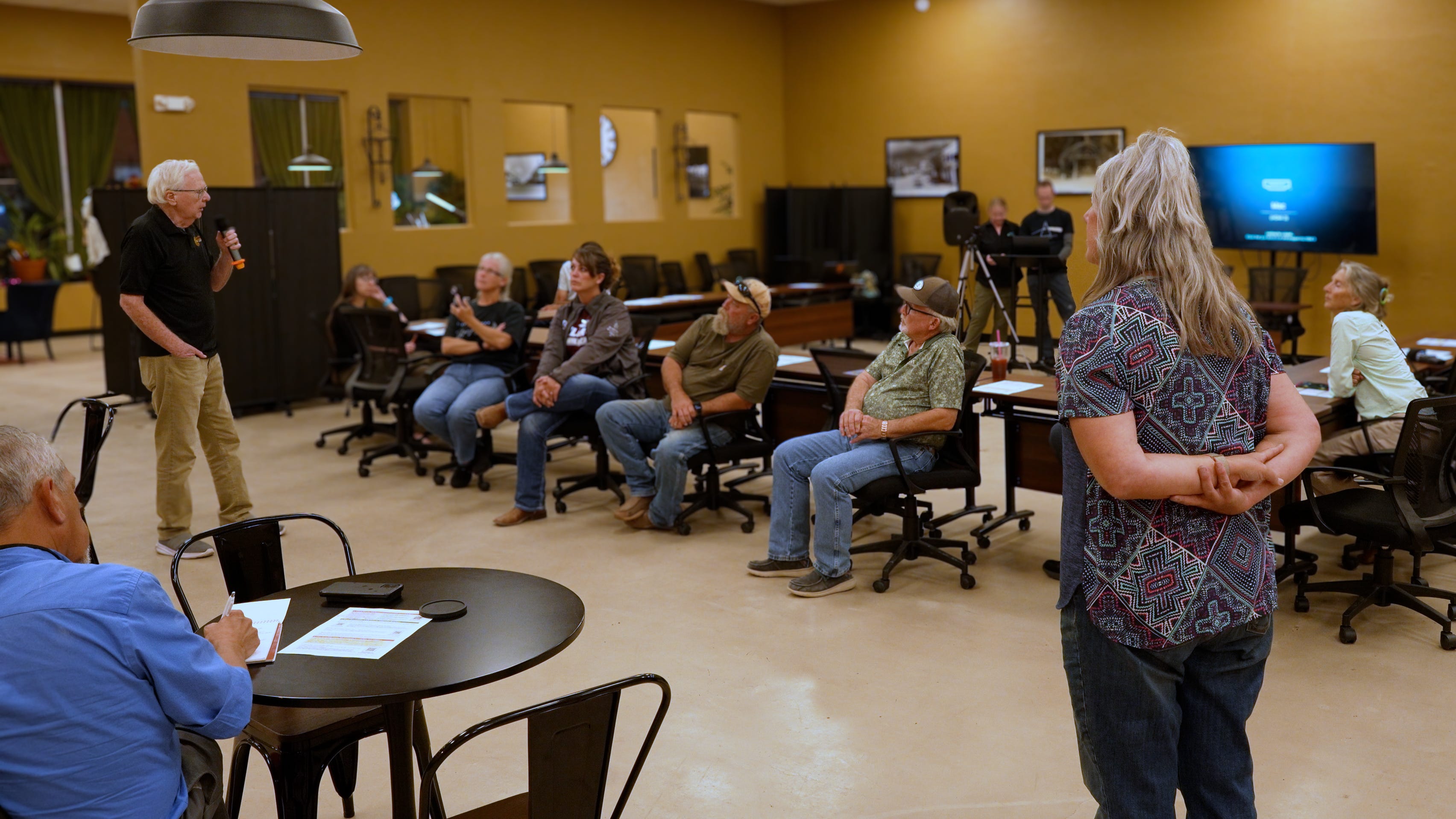
NSF’s own records show the agency began planning the demolition in 2022, four years before a mercury leak shut the observatory down. On Wednesday night, the small group working to stop it told an audience at the Ink Well Innovation Center in Alamogordo that it is running out of time.
“This is our chance … our last hurrah effort to stop this demolition,” said Heidi Sanchez, former operations manager of the Sunspot Visitor Center.
Friends of Sunspot and the BASIN Alliance hosted the public forum.
Years in the Un-Making
Organizers said the demolition schedule has moved faster than many folks realized.
The National Science Foundation and the U.S. Forest Service laid out that schedule in a joint update posted October 19.
NSF said its engineering and hazardous materials contractors concluded that tearing down the telescope completely is the safest and most efficient way to fully clean up the site, which sits in the Lincoln National Forest.
NSF records show demolition has been on the table for years.
During the forum, organizers walked the audience through a slide-show timeline of the federal decisions behind the demolition.
In 2018, NSF finished an environmental review that weighed five options for the observatory’s future. That August, the agency executed a historic-preservation agreement developed in consultation with New Mexico’s State Historic Preservation Office, the federal Advisory Council on Historic Preservation, the Forest Service, and other parties.
The agreement set out how NSF would offset the loss of historic buildings if they came down. One measure was up to $100,000 for an interpretive exhibit or signage.
NSF held public meetings during that review, federal records show. The agency told Source NM in July that the review included a public comment period and that no feasible preservation proposals came out of it.
In February 2019, NSF issued a formal decision. Its first choice was to keep the observatory running at reduced levels with outside partners and partial NSF funding for three years. Demolition and site restoration was named as the fallback if that arrangement did not work.
According to NSF, it did not. The agency says it funded the National Solar Observatory for site upkeep and New Mexico State University for science operations at the Dunn telescope. But no group came forward with a viable plan to fully fund operations or take ownership of the telescope or the observatory.
In 2022, NSF began planning for demolition. It updated its environmental and endangered-species studies and made a preliminary estimate of the cost and methods to safely take the telescope out of service. NSF continued funding operations during that period.
The mercury spill brought the plan forward. Liquid mercury was found on a worktable on the telescope’s main floor on January 5, 2026, according to NSF. The Forest Service, which manages the land, then asked the agency to remove all of the mercury and clean up the site.
NSF cited the cost of repairing the aging structure and the risks of the roughly 160 gallons of liquid mercury in the telescope’s bearings and seals. It decided to drain the mercury as soon as possible, a step it said would leave the telescope unable to operate.
In a February 24 update to its 2019 decision, NSF said it would proceed with demolishing the telescope and restoring the entire site, including the residential and support buildings.
The agency gave four reasons: the need to reduce observatory funding, the lack of a long-term partner, the risks of keeping mercury in an aging structure, and its review of the environmental effects and ways to reduce them.
Demo Schedule
Crews will build the scaffolding and begin removing the concrete tower from the top down this fall. NSF expects the telescope to be down to ground level by the end of March 2027.
NSF plans to demolish the rest of the campus in two phases and finish by the end of 2027. The first phase will remove buildings that have sat unused for long periods, and the second will remove everything else. The agency said the work follows its earlier decision to end agency-funded astronomy at the site. It said the timeline depends on the federal contracting process and coordination with the Forest Service and regulators.
Organizers pointed to a September email from NSF that, they said, suggested the community still had time to weigh in.
The October 19 update says the Forest Service will seek community input on future uses of the site once restoration is complete. It does not describe a comment period on the demolition itself.
In an October 16 report, Source NM said NSF’s chief officer for research facilities, Linnea Avallone, told one objector that stakeholders would have a chance to weigh in before any demolition beyond what mercury cleanup requires. An NSF spokesperson told the outlet the agency’s plans have not changed and it still intends to demolish the remaining facilities.
Sanchez said the agencies’ tone changed after local advocates began drawing public attention. “We start getting noticed,” she said. “And immediately, it’s no coincidence that right after that, NSF comes out with this updated statement … very clear. No, we’re demolishing the entire site and there is no discussion.”


Major Players
Sanchez said the core advocacy work has fallen to three people: herself; Sarah Moody, founder of BASIN Alliance; and Dave Dooling, president of Sunspot Community Center Inc.
She said the three have met with state officials, distributed flyers, built a social media presence, and worked their way through the federal agencies involved.
“We’re stretched thin,” Sanchez said.
“There hasn’t been a lot of progress. It’s being demolished. That’s the progress,” Moody said. “We’re here tonight as our last effort to see if the community will get behind saving this place.”
Moody said the buildings tell the story of more than 75 years of solar science, Cold War research, and the generations of scientists who lived and worked on Sacramento Peak.
“The story without the buildings … you can’t tell the same story,” she said.
Organizers cited engineering reports showing that roughly 98% of the mercury from the January spill has been removed. They said the remaining buildings are not contaminated.
NSF’s update says a separate assessment of hazardous materials inside the telescope is underway. It covers lead-based paint, asbestos, mercury, and PCBs. The results will guide how those materials are disposed of, in coordination with the New Mexico Environment Department.
NSF has not cited contamination as the reason for removing the rest of the campus. It says that work follows its decision to end agency-funded astronomy at the site and restore the land to the Forest Service.
The agency said contractors will try to salvage instruments that can be safely decontaminated. It has committed up to $100,000 for an interpretive exhibit or signage about the observatory’s contributions to solar science. It is also working with New Mexico State University and other partners to find permanent homes for significant scientific artifacts.
Advocates pointed to turnover among the federal officials overseeing Sunspot.
NSF has been without a permanent director since Sethuraman Panchanathan resigned in April 2025. President Trump nominated Jim O’Neill for the post in March, but the Senate has not acted on the nomination. Brian Stone, who has led the agency as acting director, plans to retire at the end of the year, according to the American Institute of Physics’ FYI: Science Policy News.
According to organizers of the Wednesday night meeting, the Forest Service deputy regional forester making decisions on Sunspot is on a one-year rotation.
Two Cloudcroft trustees, Keith Hamilton and Matt Willett, attended the forum.
Hamilton called Sunspot Cloudcroft’s “little sister,” part of the village’s identity since the 1950s. “Destroying it destroys part of our history, part of my history,” he said.
Willett grew up in Cloudcroft and chairs the village’s Parks and Recreation Advisory Committee. He said the community has struggled to keep up with how quickly things moved. “It went from ‘this is potentially’ to ‘it’s going to be down in three months,’” he said. “I hate to see it go away.”
Both men said they support the effort as concerned citizens. Willett said he wasn’t sure what residents are being asked to do.
“We don’t have a clear path to saving Sunspot right now,” he said.
What’s Next
NSF expects to award the contract for the first phase of campus demolition by the end of March 2027.
NSF and the Forest Service said they will keep posting updates as the work proceeds. After restoration, the Forest Service plans to consult local partners on possible future uses of the site. Interested parties can write to the Forest Service at ReImagineSunspotNM@usda.gov.
Friends of Sunspot organizers said they have launched a formal appeal asking the National Park Service to recognize Sunspot’s historic status. They asked residents to attend the Otero County Commission meeting at 9 a.m. November 10 in Alamogordo and to connect with the group at basin-alliance.org/sunspot, friendsofsunspot.com, @basin.alliance on Instagram, and the BASIN Alliance and Friends of Sunspot pages on Facebook.
This report is compiled from in-person attendance at the Wednesday, October 28 meeting and provided materials, previous reporting, independent research, interviews, and NSF documents.

Reports like this are brought to you in part by great companies like these:
The James Sewell Ice Rink
Cloudcroft’s open-air ice rink — public skating, lessons and hockey high in the New Mexico pines.Off the Beaten Path
Eclectic gifts & original artworkFuture Real Estate
Raise your expectations.Ski Cloudcroft
The Southernmost ski area in New Mexico.Cloudcroft Therapeutic Massage
Maximizing Movement, Quality of Life ImprovementHigh Altitude
Your favorite little outdoor outfitter on Burro AvenueBlushing Yucca Esthetics
✨ Book your glow-up today✨Cloudcroft Art Society
Located in Old Red Brick Schoolhouse: Holiday and Saturday art showsNoisy Water Winery
Family-owned winery crafting thoughtfully made wines from New Mexico grapes, inspired by mountain living.Be in the Mountains Yoga & Massage
A cozy space for yoga and massage therapy at the Village PlazaThe Stove and Spa Store
We offer a variety of services to ensure your hearth and spa dreams are met!The Lodge at Cloudcroft
Landmark Choice Among New Mexico ResortsHomee
Real Estate Property Management and RentalsCloudcroft Art Workshops
Enhance your artistry while enjoying the beauty and coolness of the mountains!Sacramento Camp & Conference Center
Come to the Mountain — Let God Refresh Your SoulLaughing Leaf Dispensary
Discover a world of wellness at Laughing LeafInstant Karma
Adventure Within: Transformative Yoga, Ayurvedic Wisdom, Nourishing Organics, Fair Trade BoutiqueThe Elk Shed
Purveyors of Southwest + Mountain Provisions, Goods & FineryThe PAC
Pickleball Addicts of Cloudcroft—Pickleball in the CloudsBre Hope Media
Professional photo and video services
Thank you to our supporters.
We couldn’t do this without you.

Thanks for reading. Subscribe for free articles and newsletters like this, delivered directly to your inbox.