


On a clear day, U.S. Interstate 10 near the Arizona-New Mexico border is a wide-open section of desert where drivers can see for miles.
But when the conditions line up, this corridor that crosses the Lordsburg Playa becomes engulfed in dust, and often leads to deadly pileups.
“There was one point I was doing five miles an hour on the interstate,” said Joseph Flores, a lieutenant with the Hidalgo County Sheriff’s Department. “I was having to pull over just because it got to zero visibility.”
Lieutenant Flores was one of the first responders on scene during a 2025 storm that caused an 11-car pileup and led to three deaths.
“The dust was so bad that I couldn’t see my hand in front of me, but I could hear people screaming, yelling that they needed help. And I just couldn’t get to them at that point. I didn’t know where they were at. I didn’t know if I was still on I-10 or exactly where I was standing. But I knew that people needed help, and it was kind of just the most unsettling feeling,” he said.
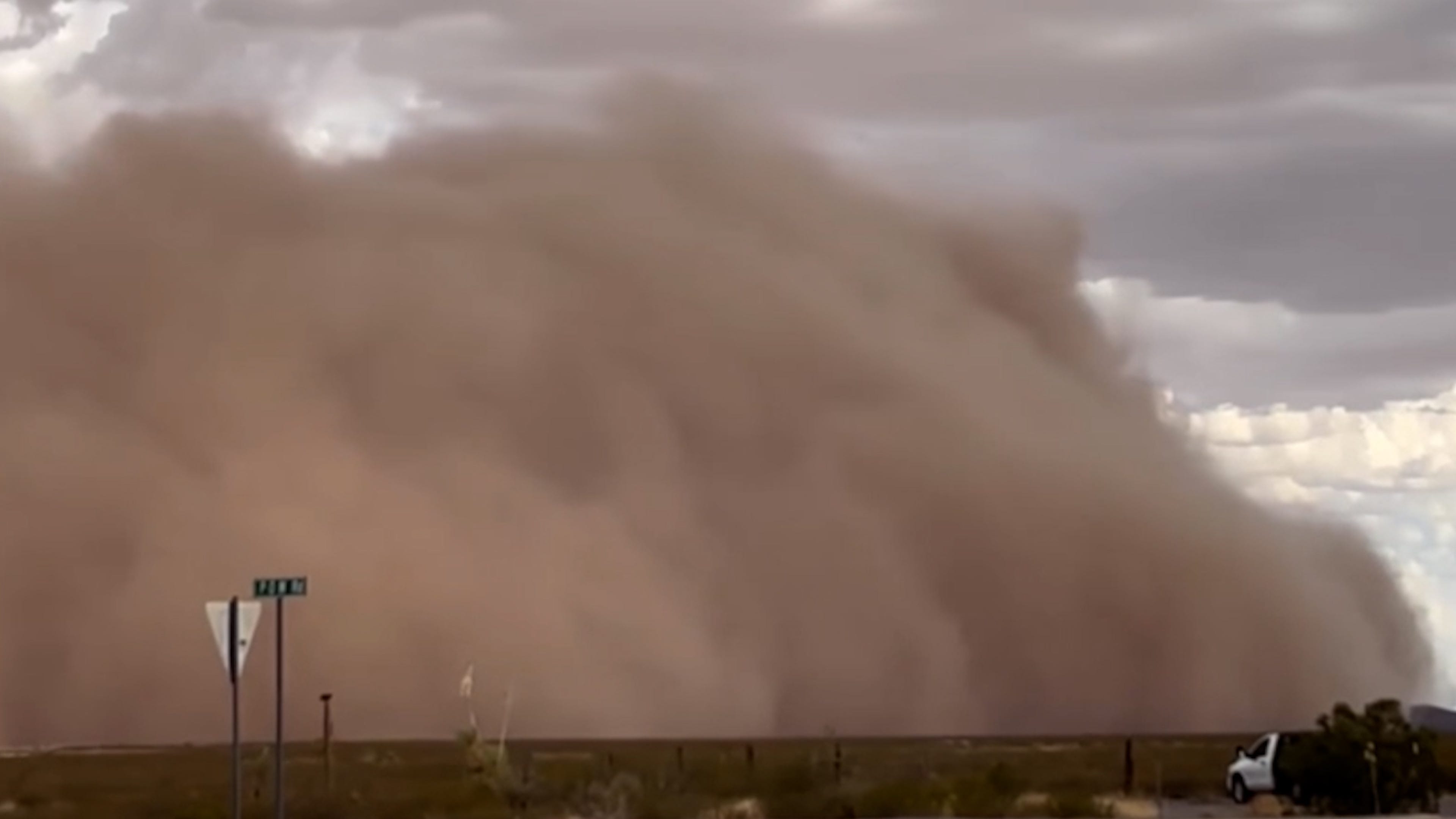
These types of events are common. According to the New Mexico Department of Transportation, there have been over 120 dust events that have caused 21 deaths in the corridor since 2012. In a county with less than 5,000 people, responding to these events takes a toll on first responders in the community, according to Hidalgo County Sheriff William Chadborn.
“It takes up every resource that we have in the county,” Chadborn said. “If there is a state police officer here, they’re tied up on that incident. The deputies are tied up on road closure or reroutes. And the same with the city.”
Beyond the headlines and crash reports, these storms are leaving a quieter toll on the people tasked with responding when things go wrong. Hidalgo county is rural, and resources are limited. When a pileup happens, it often falls on just a handful of people, according to County Manager Tisha Green.
“Most times it’s one or two deputies handling the entire situation,” Green said. “Sometimes inividuals from the road department, even myself, would go out and help set up cones, assist with not necessarily traffic control, but just out there assisting where we were needed.”
According to Green, there hasn’t been a consistent state police presence in the county, meaning that backup can come from as far as 60 miles away. To better handle emergency response, the county recently hired three additional deputies, a move Green said costs about $265,000 annually. Add in fuel, equipment, and stipends for volunteer firefighters, and the total climbs even higher.
“We’re getting upwards of close to $300,000 on what we’ve done to proactively react. But it’s been quite burdensome” Green said. “We’re going to do what we can to ensure safety the best we can. But we do need some assistance over here financially.”
To add to the logistics, fire response in the county relies on a volunteer department of 18 people, meaning uncertainty every time a call comes in, according to Fire Chief Tommy Chavez.
“We have 18 members, and it just depends on if it’s a weekend, if it’s a weekday. If it’s during the day, people can’t get out of work. Usually for these big incidents, everybody that can come, comes. Because we know it takes the maximum amount of people we have to try to deal with them. We might have 10 [or] 12 people. But there could be as few as four.”
In an effort to mitigate the cause of the problem, The New Mexico Department of Transportation has spent millions of dollars on initiatives such as vegetation restoration, cattle exclusion zones, and water retention work. The most recent mitigation work was done last fall, and more projects are in the pipeline.
Bill Hutchinson, who manages NMDOT’s roadside design program, has worked on this corridor for over a decade, and explained the complexity dealing with the landscape, which includes a fragile mix of dry soils, historic lakebeds and disturbed land, and said that climate change will make conditions worse.
“These are fragile lands. It’s not true playa, but it is uplands associated with the playa. And they are areas that are grazed under permit by the Bureau of Land Management in this instance, and the ongoing drought has made these areas even more fragile, and the cattle tend to break the surface and allow the dust to become airborn.”
Hutchinson said that his department is working with a number of different agencies to mitigate danger, including the BLM and State Land Office, who own much of the 16,000 acre zone.
“We have proposed that the entire playa be reclassified as what’s called an area of critical environmental concern, which is a BLM designation for sensitive lands,” he said. “This is a public health emergency we have down there. There are over 50 people who have died attributed to dust on I-10 in the last 40 years. So we have the documentation. We have gone through all the environmental analysis. It’s that particular proposal which was signed by the [NMDOT] secretary, is in the BLM hands and under their consideration.”
While many of the proposed solutions are complex, Lieutenant Flores pointed to a few simpler solutions, including installation of automatic gates on the interstate, and stressing the importance of not pushing through the storms.
“You do not have to drive through it. If you see that there’s dust building up, pull over to the side of the road, pull far enough over [and] turn off your vehicle. Stay in your vehicle. Turn your headlights off and keep your feet off the brakes.”
But until larger solutions take hold, Hidalgo County’s first responders will continue to do what they can.
“I just don’t know how you could ever explain to people what’s out there and what happens on a yearly basis up there.” Sheriff Chadborn said. “And I hope that someday either it starts raining or something happens where these guys don’t have to deal with it, because I don’t want my deputies to have to deal with that anymore.”
Dust storms can cause zero visibility in seconds. When encountering a storm, pull over as soon as possible, and completely exit the highway if there is an opportunity. Put your car in park and turn your vehicle off, and make sure all lights are completely off. Stay in the vehicle with seatbelts fastened while the storm passes. For more information, visit take5stayalive.com.
This report is supported by the Southern New Mexico Journalism Collaborative.
The Reader is proud to be sponsored in part by great businesses like The Lodge:

Learn about sponsorship opportunities for your business in support of the Reader. Contact us for more information at sponsorship-info@cloudcroftreader.com
Cloudcroft Reader is proud to be sponsored in part by great companies like:
Cloudcroft Art Society
Located in Old Red Brick Schoolhouse: Holiday and Saturday art showsNoisy Water Winery
Family-owned winery crafting thoughtfully made wines from New Mexico grapes, inspired by mountain living.Be in the Mountains Yoga & Massage
A cozy space for yoga and massage therapy at the Village PlazaOsha Trail Depot
Your destination for unique, hand-crafted treasuresThe Stove and Spa Store
We offer a variety of services to ensure your hearth and spa dreams are met!The Lodge at Cloudcroft
Landmark Choice Among New Mexico ResortsCloudcroft Art Workshops
Enhance your artistry while enjoying the beauty and coolness of the mountains!Sacramento Camp & Conference Center
Come to the Mountain — Let God Refresh Your SoulLaughing Leaf Dispensary
Discover a world of wellness at Laughing LeafInstant Karma
Adventure Within: Transformative Yoga, Ayurvedic Wisdom, Nourishing Organics, Fair Trade BoutiqueOff the Beaten Path
Eclectic gifts & original artworkFuture Real Estate
Raise your expectations.Ski Cloudcroft
The Southernmost ski area in New Mexico.Cloudcroft Therapeutic Massage
Maximizing Movement, Quality of Life ImprovementHigh Altitude
Your favorite little outdoor outfitter on Burro AvenueBlushing Yucca Esthetics
✨ Book your glow-up today✨The Elk Shed
Purveyors of Southwest + Mountain Provisions, Goods & FineryThe PAC
Pickleball Addicts of Cloudcroft—Pickleball in the CloudsPeñasco Valley Telephone Cooperative
For all the ways you love to connectBre Hope Media
Professional photo and video services

Thanks for reading. Subscribe for free articles and newsletters just like this, direct to your inbox.


